AZ Grid Access Charge Eliminated

On October 25th, TWW argued against Arizona's grid access charge expansion in the Arizona Corporation Commission's electric resource planning process for APS.

TWW engaged on the issue because a review of the record in the APS rate case lacked specific evidence to support the charge to rooftop solar customers that APS was seeking. TWW argued that the Commission owed it to Arizonans to ensure that customers only pay necessary fees and charges that are supported by the evidence.

The very nature of a ratemaking case gives a utility a process and opportunity to introduce evidence in support of the charges that it seeks. In this case, APS had the time and opportunity to introduce evidence into the record in support of a charge to rooftop solar customers-a charge that it has long suggested is justified.

The Western Way acknowledges that there may be an increased cost to serve solar customers. However, APS did not introduce any evidence indicating what the cost is. As such, the Commission has no way to determine the basis for the charge for which APS is seeking approval or whether such a charge is an accurate reflection of the costs of distribution generation, indeed, the Commission does not actually have any way to determine whether there is a cost to APS associated with distributed generation at all.

The Recommended Opinion and Order is clear that the Commission does not have sufficient information in the record to reach a conclusion about the costs that rooftop solar customers cause to the grid. In the absence of actual evidence of costs necessary to justify the charge, it is inappropriate for the Commission to require Arizonans with rooftop solar to continue to pay the Grid Access Charge every month.

On October 27th the ACC voted to eliminate the fee.

Solid Power is at the Forefront of All-Solid-State Batteries

Colorado based Solid Power is at the cutting edge of solid state battery technology for electric vehicles.  The company spun out of the University of Colorado Boulder with DARPA funding in 2011 and after ten years of R&D it is now on the verge of major commercialization of their solid state battery cells. 

Solid Power’s all-solid-state battery chemistry provide several advantages over lithium ion cells currently used in electric vehicles.  The technology will allow for lighter packs, increased range, longer life, more safety and a lower price point.   

Solid Power’s co-founder and CEO Doug Campbell recently noted in an interview how solid state battery packs could impact the electric vehicle industry saying, “In a solid-state battery we have replaced that volatile and flammable liquid and gel polymer electrolyte with a very stable, solid ion conducting material,” Campbell said. “Our cells may still fail, but they do so in a very benign. non-catastrophic manner... In other words, instead of a thermal runaway on your hands, you simply have a dead brick.” 

Campbell continued, ““We believe, and our partners believe, that the design of future EV battery packs incorporating solid-state batteries will be substantially simpler,” Campbell said. “So that would drive down the cost.”

In September, Solid Power announced they would be quadrupling their total manufacturing footprint which the company called “a key inflection point in the company’s mission to commercialize its all-solid-state battery technology for deployment in electric vehicles.”  The new facility will greatly expand Solid Power’s capacity to produce key materials for its all-solid-state battery cells, including the ability to produce up to 30 metric tons of sulfide-based solid electrolyte material annually, representing a 25 times throughput increase to current capacity.

Electrolyte production at the new facility is intended to directly feed the company’s forthcoming all-solid-state EV cell manufacturing line, which is expected to produce cells for automotive qualification testing and future battery pack design. Solid Power expects to produce and deliver its first 100 Ah cells for formal automotive qualification testing in 2022. Once fully qualified, Solid Power intends to work closely with automotive OEMs and top tier battery cell producers to manufacture 100 Ah all-solid-state battery cells widely for in-vehicle use.

Long term, Solid Power plans to sell the company’s proprietary sulfide-based solid electrolyte material to support full-scale all-solid-state cell production for its partners, including Ford and BMW. Solid Power also intends to sell the solid electrolyte material to other solid-state cell producers who may not be using the company’s unique all-solid-state cell designs. Solid Power is working to produce 40,000 metric tons of electrolyte material per year by 2028, which could support the annual production of 800,000 electric vehicles using the company’s all-solid-state battery cell designs.

Solid Power’s research and development activities and battery cell testing capabilities remain ongoing. Future product and material development, such as next-generation electrolytes and conversion reaction cathodes for Solid Power’s third all solid-state cell design, are anticipated.

Energy Innovation Spotlight: Watergen

When we think of energy-saving technology, we don’t always think of water. But water and energy systems are highly interdependent: water is used in energy production, and energy is required to extract, treat, and deliver water. And, like clean and affordable energy, the availability of clean, safe, and sustainable water supplies is a pressing global challenge.

According to the World Data Lab, more than 2.3 billion people around the world live in water scarce regions, meaning regions with physically scarce water resources or scarcity due to institutional or infrastructure failures leading to poor quality water, including the United States. As global needs for water and energy continue to rise given projected population and economic growth worldwide, it will be critical that we continue to look for ways to more efficiently produce and use our water and energy resources.

Atmospheric Water Generation

One such opportunity is atmospheric water generation (AWG), an innovative technology that produces drinking water from humidity in the air. The system created by Watergen, an Israel-based company founded in 2009, uses a unique energy efficient module that produces water at the point of consumption, thereby reducing the need for energy intensive production, treatment, and transport, costly infrastructure, and the volume of plastic waste.

Energy Efficient

In essence, Watergen’s patented technology uses condensation as a means of producing fresh water. The system works by quickly moving air through a unique, energy-efficient heat exchange module; by moving air through its system in a very short time, the process is highly energy efficient, extracting the maximum amount of water from the air using less energy. The system is scalable and customizable and can be used for a wide range of daily quantities, enabling Watergen to supply fresh, clean drinking water to an entire town or village, or it can be scaled down to supply enough drinking water for private homes or offices. The system can produce one liter of clean drinking water using as little as 0.3 KWH in a wide range of climatic conditions, in temperatures ranging from about 60 to 100 degrees and relative humidity of ≥25%RH.

Hard Rock, AZ

This technology is already being used in communities around the world, including in Latin America, Africa, Asia, Europe, and right here in the United States. Just this past July, for example, Watergen demonstrated its highly mobile water-generating solution in the isolated town of Hard Rock, Arizona, part of the Navajo Nation in the northeast part of the state. Like much of Arizona, the Navajo Nation has been experiencing drought and extreme weather events, and the Navajo Tribal Utility Authority is encouraging residents to conserve water. The system Watergen brought to Hard Rock produces water from the air without the need for plumbing or municipal infrastructure and uses minimal electricity. While this system may not solve all of the water challenges Arizona’s tribal communities are facing, the innovative technology is helping to bring clean, affordable drinking water in an energy-efficient way to this water-stressed region.

Microsoft

But, drought-stricken communities aren’t the only ones to put AWG to use. For example, Microsoft is employing Watergen at its new building in Herzliya, just north of Tel Aviv, which the company has touted as the greenest building in Israel. Microsoft will use the Watergen technology to provide sustainable, energy efficient drinking water to its 2,000 employees there.

While atmospheric water generation may not solve global water and energy challenges, it is one example of how technology and innovation can identify new sources of water and energy, and help us produce and use them in a more efficient way. From arid, water-stressed regions in the developing world to densely populated urban corridors to high-tech multinational corporations, we can expect to see many more technologies like this in the near future. 

Utah's Rural Renewables Generate $5.3 Billion in Economic Output

The Western Way released, “The Economic Benefits of Utah’s Rural Renewable Energy Industry.” The economic impact study was conducted by Development Research Partners and analyzed rural utility scale renewable energy projects constructed in 11 counties in Utah.

These projects account for 2,275 megawatts of nameplate capacity from solar, wind, and geothermal facilities over 10 megawatts. The report analyzed 31 projects built in Utah (5 under current development or construction slated for completion by 2023) which result in significant economic benefits to rural Utah including:

  • $5.3 billion in total output from construction and investment activity in from 2007 to 2023. • 9,051 total jobs (Direct and Indirect employees) earning $442.8 million in wages.

  • $4.1 billion from construction and investment with 4,368 full-time constructions jobs.

  • $154.4 million in total annual economic output with 568 employees earning $32.1 million annually.

  • $24.6 million in annual property taxes paid to local governments.

  • $6.3 million in annual lease payments to ranchers, farmers, and other landowners.

“During my time as Governor, I was in strong support of an All-Of-The-Above approach to energy development,” said former Governor Gary Herbert. “This is the first time I have seen quantified the state-wide economic benefit of renewable energy projects of all types in Utah. It’s impressive when you consider the megawatt output from the 31 utility-scale projects that encompass solar, wind and geothermal. The Western Way has done an excellent job guiding and sponsoring this study and our rural counties especially are benefiting greatly from this economic driver that I suspect is just going to grow.”

Renewable energy in Utah has historically been dominated by hydroelectric power, but solar, wind, and geothermal have grown in significance over the past two decades. The state’s high altitude, cooler temperatures, available sunshine, and affordable land have made the state a prime location for renewable energy development facilities.

Nearly 1 gigawatt of utility-scale solar in Utah was built in 2015 and 2016, more capacity than hydroelectric, geothermal, and wind combined, creating a large spike in renewable energy production in recent years. Electricity generation from all solar facilities, both small-scale and utility-scale, accounted for about 58 percent of the state’s renewable generation and was 30 times greater than in 2015. At the end of 2020, Utah ranked 10th among the states in the amount of solar generating capacity, with 1,525 MW installed.

The release of the report drew support from elected officials and Utah leaders:

“We’ve known for some time that a dramatic change is happening with the transition to new energy but I don’t think anyone knew that it’s having a $5.3 billion economic impact in Utah. The fact that workers in construction and maintenance has risen to over 9,000 is impressive. This number is just going to grow and I’m pleased that rural Utah is benefiting so much from these projects.”

J Stuart Adams President Utah State Senate

“The transition to new energy is happening very rapidly but some have questioned whether or not the economic impact is significant. This new study highlights and proves that renewable energy development has brought significant investment to the state. $4.1 billion in construction and investment from 2007 projected to 2023 is pretty impressive! I think we’re just seeing the tip of the iceberg. When it comes to wind, solar, and geothermal, money and markets are flowing together in an impressive and significant way and the positive economic impact of these projects in Utah is going to continue at break-neck speed.”

Stephen G. Handy Representative Utah House of Representatives

“In Beaver County we have to use the assets we have for economic development and with plenty of sunshine and wide-open spaces we have become one of the most-desirable locations for utility-scale solar in Utah. Renewable energy facilities have brought significant development to Beaver County and we expect it to continue. We are excited about the positive economic impact these projects are having to create jobs and tax revenue.”

Mark Whitney Commissioner, Beaver County

“The new report sponsored by The Western Way highlights the economic impact of renewable energy development and projects throughout the state. I’m really pleased to see what’s happening in Iron County and quantified here in this report. We are also excited about some of the geothermal activity that’s taking place over in New Castle. This could be really exciting in terms of additional job creation and positive economic activity for Iron County.”

Paul Cozzens Commissioner, Iron County

“This new report provides a comprehensive assessment of the economic impacts renewable energy – solar, wind, and geothermal – are making in Utah, fostering a rural renaissance across the state in terms of investment and monetary impacts, local jobs, and tax revenues. This report should give state, county and city policymakers the assurance that local projects will benefit their neighbors and communities.”

Edwin R. Stafford Ph.D. Professor of Marketing Jon M. Huntsman School of Business Utah State University

TWW Congratulates Leaders During National Clean Energy Week

National Clean Energy Week, September 20th to 24th, highlighted the various policies, industries, and innovations that power our country with lower or zero carbon emissions. Industry participants represented a full spectrum of energy producers including natural gas, nuclear, carbon sequestration, wind, solar, biogas and more.

Policy makers across the Western U.S. highlighted the importance of clean energy. TWW congratulated western congressmen for supporting a resolution in Congress highlighting clean energy’s importance to the environment and its contributions to the economy.

Clean Energy Resolution Thanks.png

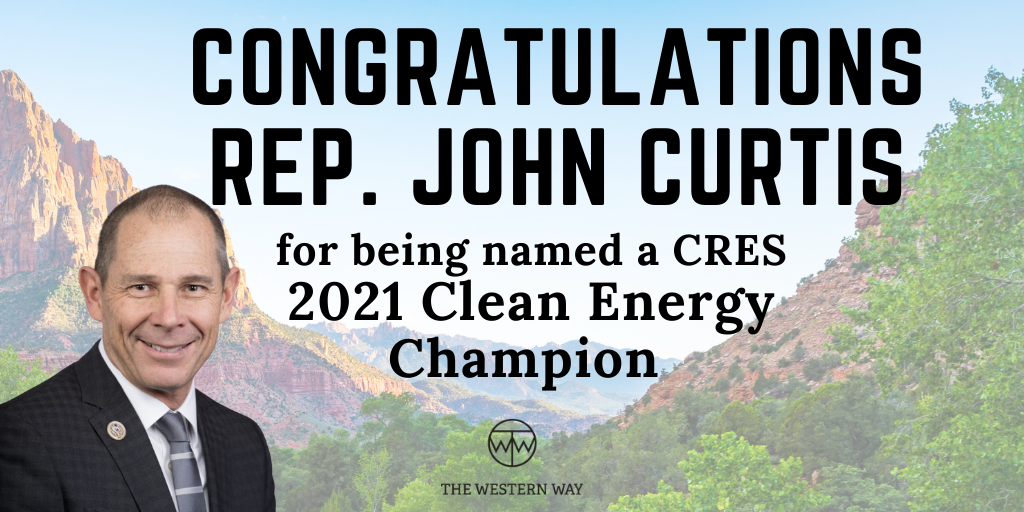
TWW also congratulated Congressman John Curtis of Utah for being named a 2021 CRES Clean Energy Champion during the week due to his leadership in supporting all of the above energy and American innovation to drive economic growth and responsible stewardship of the environment.

Curtis Congratulations (5).png

Energy Innovation Spotlight: First Solar

As more and more states have worked to meet their energy needs from clean and renewable sources, the growth of the solar industry has skyrocketed. According to the U.S. Department of Energy, U.S. solar capacity has grown from just 0.34 GW in 2008 to nearly 100 GW today--enough to power the equivalent of 18 million average American homes. And the price of solar energy, which at its inception was prohibitively expensive for many applications, has fallen dramatically: since 2014, the average cost of solar PV panels has dropped nearly 70%, and solar electricity is now economically competitive with conventional energy sources in most states.

R&D Focus

Significant investment in research and development has driven the tremendous advances in solar technology, and the correlating drop in cost, that we have seen over the last several decades. Arizona-based First Solar has been part of that effort since the 1990s and is now the largest domestic solar manufacturer, with thousands of employees across the United States. The company is a leader in the solar industry, developing, engineering and operating some of the world’s largest grid-connected photovoltaic power plants. It offers corporate, utility scale, and distributed generation solutions as well as opportunities for developers to integrate First Solar technology into new developments.

First Solar prides itself on sustainability and a commitment to “responsible solar.” This overall commitment to sustainability means First Solar isn’t just producing solar panels, but it is producing solar panels with the least possible environmental impact, manufacturing them using less energy, water and semiconductor material and resulting in the best environmental profile in the industry. First Solar is also a long-standing leader in global photovoltaic recycling services for its modules. Since 2009, the company has reduced its energy, water, waste, and carbon intensity per watt produced through improvements in module efficiency, manufacturing throughput and capacity utilization, as well as by implementing resource conservation projects at its facilities. And, just last month, First Solar announced a commitment to achieve net-zero emissions by 2050.

U.S. Made Panels

First Solar is also unique in the solar industry in that it largely sources supplies and produces its panels here in the United States, without the use of polycrystalline silicon, a critical raw material used in most other solar panels and is primarily manufactured in China. Because of its dominance in polycrystalline silicon manufacturing, China has maintained a firm grip on the global solar industry despite environmental and human rights concerns among federal lawmakers. In contrast, First Solar’s domestically-produced panels are made using advanced thin film photovoltaic (PV) modules, which are a competitive, high-performance, lower-carbon alternative to conventional crystalline silicon PV panels. The importance of First Solar’s commitment to domestic manufacturing is critical as we think about energy security and decoupling U.S. dependency on China.

Helping Meet Private Sector Goals

In addition to its corporate sustainability goals, First Solar is also helping other major corporations meet their own emissions targets. For example, Microsoft is on track to meet its goal of 100 percent renewable energy supply by 2025 for all of its data centers, buildings and campuses with the help of First Solar technology. Microsoft’s new energy-efficient datacenter region in Arizona, called the Azure cloud data center region offering Microsoft cloud services starting this year, will be powered by First Solar’s Sun Streams 2 photovoltaic solar plant and provide the lowest carbon solar electricity available today using First Solar’s proprietary Series 6 module technology. The Series 6 module has a carbon footprint that is up to six times lower than conventional crystalline silicon panels.

Planning for Future Growth

According to the U.S. Department of Energy, PV panels on just 22,000 square miles of the nation’s total land area – about the size of Lake Michigan – could supply enough electricity to power the entire United States. Although we have seen significant growth in solar energy generation, solar accounted for just 2.3 percent of total U.S. electricity in 2020. In sunny Arizona, which is ranked fourth in the nation for solar-powered electricity generation, that percentage was slightly higher, with roughly 8 percent of Arizona’s electricity generation coming from solar. That means there is still tremendous growth potential for solar in the United States, and First Solar is already preparing for it. According to First Solar CEO Mark Widmer, the company will have the capacity to generate panels that produce 6 GW of power annually domestically by 2025. While this still represents a fraction of the growth potential, it demonstrates how First Solar is thinking about future potential of solar generation.

First Solar has played a critical role in the growth and development of solar technology in the United States. Through innovation and a demonstrated commitment to sustainability and responsible production and manufacturing processes, First Solar is demonstrating what it means to be an innovative company.

Energy Innovation Spotlight: KORE Power's Domestic Battery Storage Supply Chain

Domestic battery storage manufacturing will play a crucial role in ensuring future grid reliability and security. Until recently, battery storage options--necessary for capturing and deploying intermittent energy resources like wind and solar in the most advantageous way--have not been readily available due to both technology limitations as well as very high costs. But the world of battery storage has changed dramatically over the last decade, as technology and production have ramped up and prices have fallen. Batteries are now positioned to play a meaningful role in the transition to emissions free energy generation. There is a front-of-meter storage boom that is driving U.S. based investment and creating a new domestic market. The front-of-meter energy storage segment is expected to grow to more than 5 gigawatts and $4.3 billion annually by 2025.

However, the U.S. is overly reliant on imported battery cells and components from Asia and must take steps to ensure that a domestic supply chain is available as battery storage becomes essential to our domestic energy security.

Idaho based, KORE Power understands this need and is leading the charge to build out a domestic battery storage supply chain. KORE Power produces its battery cells in a highly automated and state-of-the-art manufacturing facility, and it prioritizes research and development so that it is constantly improving its technology and manufacturing process.

KORE Power’s recent announcement that it will build a one-million square foot lithium ion battery manufacturing facility in Maricopa County, Arizona--the “KOREplex” as it is being called--will be the first manufacturing facility of its kind in the United States. The facility will operate at net-zero carbon emissions through strategic partnerships and solar-plus- and storage co-generation, and will help KORE meet its goal of scaling up annual production from 2 GWh to 12 GWh in order to serve the rapidly growing battery market. The new facility will also create more than 3,000 new advanced manufacturing jobs in Arizona and strengthen U.S. energy security by creating a robust domestic battery cell supply.

A recent white paper from Wood MacKenzie, Building a Secure Domestic Supply Chain for Energy Storage, details the importance of a domestic battery storage manufacturing capability.

“Despite leading the world in grid-scale energy storage deployment, the U.S. has lagged in the race to become a global leader in energy storage manufacturing. While U.S. national laboratories maintain world-class R&D capabilities, the cells that form the core of these batteries are nearly all imported from manufacturers in China, South Korea and Japan. In some ways, it is a familiar story, similar to how the U.S. effectively ceded the job creation and economic benefits of solar manufacturing to the Asian countries that aggressively backed that industry more than a decade ago. As battery storage becomes more essential to modern electricity systems at every scale, dependence on imported cells constitute a real risk to U.S. energy security.”

Even the Department of Defense has recognized the vulnerability to the military due to an import reliant battery storage supply chain. A 2018 report on the U.S. industrial base noted:

“Most domestic lithium-ion cell packagers rely on foreign commercial lithium-ion cell suppliers from countries such as South Korea, China, and Taiwan. Cell availability for military battery packaging is a risk across the board for rechargeable batteries.”

KORE Power is playing an important role creating high-impact and functional solutions to modern-energy challenges, and it is demonstrating how accelerating domestic battery storage innovation and manufacturing supports the economy and is vital for our domestic energy security.


Energy Innovation Spotlight: Idaho Milk Products

When Idaho Milk Products had the opportunity to design and build a new dairy processing facility in Jerome, ID, they set out to create a plant that would operate as energy and resource efficient as possible.  Now the facility is estimated to save enough energy annually to power nearly 400 homes and has reduced wastewater effluent by 70%.  This week Idaho Power awarded Idaho Milk Products a $97,000 cash incentive for their efforts in reducing energy consumption. 

“We commend Idaho Milk Products on their impressive energy efficiency efforts and this well-deserved incentive,” commented Leo Sanchez, Key Accounts Energy Advisor with Idaho Power. “We look forward to our continued partnership as we help them reach their energy goals.”

Steps taken at the Idaho Milk plant to reduce energy demand and drive efficiency include: 

  • PROCESSING PUMP VARIABLE FREQUENCY DRIVES (VFDs) The process has 24 pumps, which can be controlled with either a control/throttling valve or a VFD. This measure includes selecting VFDs on the pumps where either option is possible.

  • TWO-STAGE VARIABLE SPEED COMPRESSORS Two-stage compressors produce more air for the same power, allowing the compressors to operate at a lower percentage of full load. This measure also includes a cycling dryer instead of a non-cycling dryer. 

  • LIGHTING This measure upgrades the plant lighting from a system designed primarily around metal halide fixtures to a system designed primarily with fluorescent T8 fixtures. Also, lighting controls are specified to turn off the lights when possible using occupancy sensors.

  • COOLING TOWER FANS AND CONTROL UPGRADES The refrigeration system provides chilled glycol to the plant. The system has four chiller packages and four corresponding cooling towers. This measure includes VFDs to control the cooling tower fans. Also, the control algorithms for sequencing the cooling towers and for determining the temperature control set point are modified. 

  • BOILER FEED WATER PUMP VFDs The boiler feed water pumps are designed to provide the required pressure at the maximum flow rate. As the required flow decreases, the pump discharge pressure increases. By reducing the pump speed, the required flow can be provided without increasing the pressure above the minimum requirement.

Idaho Milk is continuously seeking new ways to save energy and investing in the reliability of their electrical system. This has reduced the impact from transient switching, surges, and frequency shifts. They also replaced fluorescent light bulbs rated at 40 watts per bulb with LED light bulbs rated at 16.5 watts per bulb. The annual energy savings totals over 1.3 million kWh. Idaho Milk also participates in the Idaho Power Flex Peak Program, which motivates participants to reduce their electric load during Idaho Power initiated demand response events, six times per year. This saves 1,200 kilowatts each time for an annual savings of 7,200 kilowatts.

Thanks to the energy savings and demand response measures, Idaho Milk estimates they save 4.2 million fewer kilowatt hours annually.   Such savings are a prime example of how prudent investments in efficiency can quickly payoff and not only improve financial performance but also benefit the environment.

EV Manufacturing Continues to Grow in AZ

There is rarely a week that has gone by this summer without a company announcing plans to heavily invest in Arizona’s growing EV sector. This week it was, Zero Electric Vehicles which made public their plans to build out a new 103,000 sqft EV manufacturing facility in Gilbert, AZ. The company plans to move in by December 1, 2021 and create 300 new jobs.

ZEV is an Arizona based company which provides turnkey solutions to electrify existing light and medium fleet vehicles.

ZEV's location is strategically positioned to capitalize on their partnership with Arizona State University (ASU) to build on their incredible talent pool while developing new relationships with Grand Canyon University (GCU) and Maricopa County Community Colleges. "ZEV values the incredible talent coming through these college programs, we have over four graduates with patent filings in less than 6 months of development – that is rapid innovation," said Jim Maury, ZEV President.

ZEV will be expanding their fleet vehicle conversion production to 40 vehicles per day by Spring of 2022. ZEV has allocated 10K square feet to accelerate battery module design, development, certification and assembly to support fleet and passenger vehicle applications. This will bring high tech jobs, with expertise in battery cell chemistries, packaging, thermal management, and control interfaces to maximize energy density, configurability and safety through the vehicle lifecycle.

"It's with great excitement that we Welcome ZEV to Gilbert in their new 103,000 SQ FT stand-alone location on Germann Road! ZEV plans to hire 300 local employees over the next 12 months. We are grateful that ZEV chose Gilbert and thrilled for them to add to Gilbert's thriving business community," said Mayor Brigette Peterson, Gilbert City.

TWW Thanks AZ Sen. Shope and Rep. Osborne for Leadership on Heritage Fund

The Western Way thanks Arizona State Representative Joanne Osborne (District 13) and State Senator Thomas “T.J.” Shope, JR (District 8) for their leadership during the 2021 legislative session to help restore funding to the Arizona Heritage Fund. Thanks to Rep. Osborne, Sen. Shope, their colleagues in the legislature, and Governor Doug Ducey, the fund was restored to received a total of $10 million in 2021.

The Heritage Fund has made a significant impact to not just wildlife conservation efforts in Arizona, but also to the state’s economy, public access, and outdoor recreation. In 1990, the Heritage Fund was created by voters when they passed a ballot initiative by a 2-1 ratio. However, funding was cut in 2010 to deal with impacts of the the Great Recession.

Shope AZ.jpeg

“After 11 years, our state’s executive and legislative branches finally came together to fund the State Parks Heritage Fund to maintain and upgrade the growing number of parks, trails and historic preservation projects that have languished or are newly proposed in every municipality, county and tribal area in our state. I’m excited to see what projects start coming out of the ground to enhance the communities in which they’re located.”

-Sen. T.J. Shope, R-Coolidge

joanne_osborne.jpeg

“My family came to Arizona in the late 1800s. Our state’s history can be found in so many places and needs to be preserved for future generations. Arizona is a unique and special place from its glorious lands to incredible places. Let’s keep the West alive and our Arizona way. It was an honor to carry the bill to advocate for funding for the State Parks Heritage Fund.”

-Rep. Joanne Osborne, R-Goodyear


POINT/COUNTERPOINT: Who is responsible for Colorado’s bad air quality?

TWW’s Colorado State Director, Greg Brophy argues how poor federal management of forests and public lands caused the recent poor air quality problems impacting Colorado and the Western United States. The piece ran in The Colorado Springs Gazette’s Point/Counterpoint opinion section on August 22, 2021 and can be accessed here.

The Counterpoint section argues that the poor air quality was caused by the oil and gas industry and lack of policymakers and regulators actions to put the industry out of business. The fact is that Colorado has some of the most stringent regulations and laws in the country governing the oil and gas industry. Preventing the industry from operating in Colorado would not have had any impact on the air quality that the state experienced this summer which ranked among the worst in the world.

Who is responsible for Colorado’s bad air quality?

Point: Greg Brophy

In 2002, one of the largest forest fires in Colorado history ripped across our state and it was all within eyesight of the Denver metro area. My first year in the Colorado Legislature was 2003, and I’ll never forget the Colorado State Forest Service’s presentation to state leaders showing how the Hayman fire affected state versus federal lands. In areas managed by the state, where trees were thinned, the land was starting to recover. In the national forests, the overgrown timber caused the fires to burn so intensely that it left the land scorched and resembling a sterile moonscape that might never regain its former majestic state.

Fast forward 20 years, and the problem has grown worse. Over the past month, Colorado has been experiencing dangerous air quality levels caused by forest fires burning across the West. When driving from Wray into Denver, I can typically see the mountains as soon as I pass Akron. Last week, I could not see the mountains, not even from Denver.

We need to call a spade a spade on this problem. If you trust science and data, it will lead you to one conclusion: the size of forest fires, their growing devastation, and the secondary impacts to our air and water are primarily a result of over a century of federal forest mismanagement.

This is not a new issue or phenomenon. In 1910, a massive 3-million-acre fire burned across three states and the U.S. Forest Service, implemented a new policy to extinguish every fire as quickly as possible, by 10 a.m. if possible. This was a critical historical pivot — enacting an overly broad measure that essentially disrupted the natural and necessary process of wildfires.

This short-sighted policy change was made exponentially more dangerous when extreme environmental groups went to war with the logging industry. Environmentalists won this fight too, enacting logging bans rather than managed logging activities.

In the early 20th century, there was an average of 19 trees per acre in the Stanislaus National Forest in Northern California; today there are 260 trees per acre in the same forest. Colorado forests grow an estimated 1.5 billion board feet per year, but we allow less than 5% of that growth to be harvested.

Give credit where it is due — extreme environmental groups have been extraordinarily successful in implementing their preferred forest “plan.” In 2021, the trophies for their success can be viewed across the western United States — thousands of acres of forest lands that are a tinder box of dead, overgrown flammable material awaiting ignition.

This was a natural and inevitable result of federal forest policies crafted by extreme environmental groups: compounding buildup of combustible material that makes wildfires fires hotter, more dangerous, and more devastating. It leads to massive wildfires, severe air quality problems, and growing water quality problems as watersheds are increasing polluted by the burns.

For the majority of citizens willing to act on data rather innuendo here is an inescapable fact — properly managed forests will burn with reduced devastation and recover more quickly than the out of control, overgrown messes we have today.

The extreme air quality experienced along Colorado’s Front Range this past month is the latest result of extreme mismanagement of federal forests. The health and economic devastation caused by this mismanagement disproportionately affects western states. It is time that extreme special interest groups spread along the eastern seaboard be placed in timeout and empower proven forest management experts from western states to lead federal forest management back to a common-sense solution that protects our health, environment and economies.

Greg Brophy is a former state legislator from the Eastern Plains and the Colorado director of The Western Way (www.thewesternway.org), a conservative nonprofit that seeks pro-market solutions to environmental challenges.

Wind Development is a Property Rights Issue

This piece first ran in the Akron News Reporter on August 8, 2021:

By Greg Brophy

As technology advances our rural landscape changes.  Just as wooden oil derricks were once a common site in the early 20th century but then gave way to modern drilling rigs, wind energy has advanced from its early iconic windmills used to pump water to today’s utility scale turbines capable of generating 3MW of electricity. 

If we attempt to prevent this change through government regulation we need to do so with a full understanding of the implications.   Currently Washington County has a set of proposed ordinances that intend to limit wind energy development but in practice would completely ban any utility scale wind development in the county.  

The proposed restrictions in Washington County include a 410 foot height limit on turbines, a 1.25 mile setback from neighboring homes, and a .5 mile setback from property lines.  Each of these individual restrictions could potentially prohibit all wind development but taken as a package there would be virtually no chance of future development in the county. 

Nearly every modern wind turbine exceeds the proposed height, almost all turbines being built today are 480 feet or taller. New turbines planned for the next two to five years will be even taller because more consistent and powerful wind resources are typically found at greater heights.  The taller the tower the more efficient and cost effective the turbine is to operate.  It’s almost the same as insisting that no one use wheat heads in Washington County that are wider than 20 feet.  They technically work, but no custom harvester is going to show up in WashCo with a head that small.

Both the setback of 1.25 miles from neighboring homes and a .5 miles setback from property lines creates serious implications for landowners and their rights to use their property as they deem most productive.  The 1.25 mile setback essentially gives small acreage land owners control of a 1.25 mile radius of land, or 3,100 acres, surrounding their property; they would control land that they do not own.  The .5 miles setback from property lines would require a landowner to own tens of thousands of contiguous acres that are not broken up by county roads.  An owner of a 1 mile by 1 mile section would be prohibited from putting up a turbine because when taking into account the diameter of the turbine footprint, a turbine in the exact center would push into the .5 mile exclusion.  Taking both of the setback requirements together would be a de facto ban on wind anywhere there are houses or property holdings intersected by county roads. 

When the Governor from Boulder pushed oil and gas setbacks that were de facto development bans, Eastern Colorado rightly and resoundingly said “no”.  There should be no difference this time around just because the energy source has changed.  Energy development is a common use of land in eastern Colorado and it should be the landowner’s choice to develop, not the government’s.

I trust that the Washington County Commissioners will do what is in the best interest of the citizens of the county.  I sincerely hope that they understand that the current restrictions are effectively a ban on wind development and approving the restrictions will have serious consequences.  Washington County will lose out on tax revenue (paid mostly by people in Denver and Boulder), landowner lease payments and much needed economic activity and local jobs.  Just to the south, Kit Carson and Lincoln counties’ renewable energy facilities generate annual county and district tax revenue of $3.7 million and $2.8 million respectively.  This revenue can be used at the county and special district’s discretion and will remain a constant source for at least 20 to 30 years without price fluctuations.  Landowners in Kit Carson and Lincoln counties who lease their property to house turbines are estimated to earn up to $10,000 per year per turbine.  Across the Eastern Plains it is estimated that landowners receive $15.2 million annually from renewable energy leases which flows into local economies benefiting the entire region. 

Washington County has every right to draft land use requirements as it sees fit but the commissioners must balance the rights of landowners to utilize their land for its highest productive use and should be cautious when approving a ban in the guise of a restriction.  The wind development that will happen in the next five years may never be repeated.  If you miss out on this chance, there is no guarantee that you will get another.

Greg Brophy is a former state legislator from the Eastern Plains and the Colorado director of The Western Way (www.thewesternway.org), a conservative nonprofit that seeks pro-market solutions to environmental challenges.

TWW Congratulates Conservative Clean Energy Champions

The Western Way highlighted and congratulated the following elected officials from the Western United States for being named 2021 Conservative Clean Energy Champions by the organization Conservatives for a Clean Energy Future (CCEF).

Conservative Clean Energy Champions are state and local policymakers who have shown consistent and exceptional support for conservative policy initiatives that promote renewable energy and energy efficiency. Champions have worked on issues ranging from net metering and third-party ownership to energy efficiency, renewable siting, and more, to make clean energy technology more accessible to ratepayers.

Congratulations!


Arizona Lands 1 Million Square Foot Battery Manufacturing Facility

Arizona continued to build on its leadership as a preferred home of the fast growing EV manufacturing sector this month with the announcement of Kore Power’s massive manufacturing facility. Kore Power is a leading battery cell technology company and will be building a 1 million square foot facility in Buckeye. The “KOREPlex” will employ 3,000 employees at or above a median salary of $51,000.

“Arizona is thrilled to be selected as the home of the country’s first U.S.-owned lithium-ion battery manufacturing facility,” said Governor Doug Ducey. “Not only will this facility create thousands of new jobs, it will position Arizona as an anchor in the global battery manufacturing supply chain. We’re grateful to CEO Lindsay Gorrill and the entire KORE Power team for choosing our state. We look forward to partnering in your success for many years to come to further sustainability here in Arizona around the world.”

The KOREPlex, will support up to 12 gigawatt hours (GWh) of battery cell production to ensure a reliable and independent U.S. supply chain for lithium-ion battery cells that are critical to the future of electric vehicles, power grids and more. The facility will have the capacity to produce enough power for 3.2 million homes each year. KORE plans to start construction of the facility by the end of the year with the goal of beginning production in Q2 2023.

“We needed a location for our factory that had a track record of supporting energy storage, a growing clean transportation sector, and a workforce that could deliver American-made battery technology that the supply chain so desperately needs,” said Lindsay Gorrill, KORE Power CEO. “Arizona hit a home run. We’re fully committed to be a cornerstone of the state’s clean economy and we’re proud to bring advanced cell manufacturing home to the U.S.”

Arizona is a Hotbed for Clean Energy Innovation

Arizona is a hotbed for clean energy innovation. Arizona’s entrepreneurial business climate, coupled with the high quality of life and relatively low cost of living, has drawn both highly skilled workers and the innovative companies who need them. From electric vehicle companies to microchip manufacturers to large businesses with robust clean energy and sustainability goals, more and more companies now call Arizona home. According to the Arizona Commerce Authority, between 2015 and 2020 at least 634 companies have relocated or expanded in Arizona. Among them are electric vehicle manufacturers Lucid Motors, Nikola Motor Company, ElectraMeccanica, and Atlis Motor Vehicles, who together are changing the future of the motor vehicle industry. And, amid a global semiconductor shortage, Arizona will now be home to three major semiconductor factories, including major expansions by Intel and Taiwan Semiconductor Manufacturing Co.  

In addition, just this month Microsoft launched a long-awaited data center region in Arizona, made up of three separate facilities just outside Phoenix. The company said it chose Arizona for its facility because of its “abundant solar energy, highly skilled workforce, proximity to our customers, and availability of land.” In order to meet its corporate sustainability goals, Microsoft’s new facilities will use a combination of solar power, renewable energy certificates to offset energy use, and adiabatic cooling, which uses outside air instead of water cooling when temperatures are below 85 degrees. In particular, the facilities will be using solar panels from Arizona company First Solar, which uses an innovative process for solar panel manufacturing that is more energy efficient, uses less water, and creates panels that are designed to be recycled. Microsoft will also be participating in water conservation efforts to balance its current and future water use.

These are but a few examples of how Arizona’s entrepreneurial business climate has attracted companies focused on clean energy innovation, with positive impacts for Arizona’s economy, workforce, and environment. With this kind of momentum and commitment from Arizona’s leaders at all levels, Arizona’s drive to lead the innovation economy is sure to continue.

145 MW Panorama Wind Farm to Create 185 Jobs in Colorado

US-based renewable energy company Guzman Energy has signed a power purchase agreement (PPA) with Leeward Renewable Energy for the Panorama Wind Farm in Weld County Colorado.

The 145MW wind farm will be Leeward’s third project in Weld County. In its construction phase, the project is expected to create a total of 185 jobs and will also support jobs at Vestas manufacturing sites located in Colorado.

Guzman Energy CEO Chris Riley said:

“Electric cooperatives, municipalities and tribes are clear that they want access to affordable, reliable and clean energy.

“The Panorama Wind Farm will be an important source of power for our current and future customers in Colorado, New Mexico and Wyoming who are seeking reliable power at reliable prices.

“It makes strategic sense for Guzman Energy to be part of the Panorama Wind Farm as we continually leverage both owned and contracted energy sources to meet our customers’ needs.”

Vestas, with factories based in Colorado, will provide a mix of 2 MW platform turbines including V120-2.2 MW, V110-2.2 MW, and V110-2.0 MW turbines.

“We’re proud to once again partner with Leeward Renewable Energy on a project that extends the successful run of Vestas’ 2 MW platform in the state,” said Jeff Fuchs, Vice President of Sales for Vestas in North America. 

“Leeward is pleased to partner with Vestas and deliver sustainable wind energy and economic benefits to the people of Colorado,” said Andrew Flanagan, Leeward Renewable Energy’s Chief Development Officer. 

The order includes supply and commissioning of the turbines, as well as a 20-year Active Output Management 5000 (AOM 5000) service agreement, designed to ensure optimised performance of the asset. 

Construction work at the site is expected to begin next month and turbine delivery will begin in the third quarter of 2021 and construction is expected to be completed in December 2021. 

TWW Supports Colorado's Innovative Energy Projects Legislation

TWW's Greg Brophy testified in support of HB-1324 which was heard this month at the Colorado Capitol. The bipartisan bill focuses on creating a framework within the Colorado Public Utilities Commission to drive innovative energy projects from research and development into commercialization. Specifically it would allow Xcel Energy to propose innovative energy technology projects that can deliver the next generation of clean energy while being located in rural communities impacted by energy transition in order to provide tax revenues and jobs.

The bill aims to achieve several goals:

  • Spur innovative energy technology projects which attract and retain new business, workforce development, and economic growth in areas impacted by the clean energy transition.

  • Create industry and public-private partnerships critical to achieving zero-carbon electricity. 

  • Develop a regulatory framework to attract federal and other public funding/grant opportunities to support innovative technology and robust investment in rural areas impacted by the rapid transition to clean energy.

Several guardrails have been included in the legislation to ensure proper ratepayer protection and follow the current system of PUC approvals and reviews:

  • Location:  Projects must be located in communities impacted by energy transition to facilitate an active role in the clean energy transition, replace tax revenue displaced by the early retirement of fossil generation and utility workforce transition opportunities.

  • Timing: Projects can only be proposed as part of Xcel Energy’s current Electric Resource Plan (ERP).   Legislation sunsets in 2024.

  • Cost:  Projects are be competitively bid within the ERP and under an existing retail rate impact established within SB19-236; prioritizes a portion of that overall investment to areas impacted by the plan.

  • Size:  Projects cannot exceed a negotiated amount of 300MW in size.

  • Approvals:  Projects must gain approval by the Public Utilities Commission (PUC) with consideration to both clean energy goals and the advancement of community and workforce transition. 

Arizona Moves Closer on Energy Rules Modernization

The Arizona Corporation Commission (ACC) voted on May 26th to advance the rulemaking process for the state’s Energy Rules.  The rules have been the subject of ongoing debate and an open docket of work for nearly three years. Amendments made to the rules will require a public comment period that will be open until August 20th. After that date and after the results of a costs analysis, the ACC will take a final vote on the package. 

Several amendments were adopted during the May 26th Special Open Meeting, the result of the compromises made between Commissioners which helped to win the necessary 3 votes (Kennedy, O’Connor, and Tovar) to advance the rules package. Notable among the amendments was a joint amendment from Commissioner Anna Tovar and Commissioner Jim O’Connor which extended the deadline by which utilities must reach 100% carbon-free emissions from 2050 to 2070, with interim standards beginning with a 50% reduction by 2032, a 65% reduction by 2040, an 80% reduction by 2050, and a 95% reduction by 2060.

Commissioners Tovar and O’Connor offered three additional amendments which were adopted that will add a Ratepayer Impact Measure Test, make changes to the portfolio options utilities must put forth in their Integrated Resource Plans, and add the definition of ‘All Source’ which includes supply-side and demand-side resources.

Chairwoman Lea Márquez Peterson also offered an amendment which was adopted that will allow a utility to seek a fair return on the fair value of the reasonable and prudent, used and useful investments made in demand-side resources, such as energy efficiency and demand response.

Commissioner O’Connor said before the vote:

“I think 100% is a smart target to shoot for, but I really believe the industry needs more time to get there. That implies flexibility and again most importantly leaves the utility companies in control of how they construct their energy portfolios. Let’s have them shooting high. Hopefully in the decades to come there will be very smart public servants in these jobs holding utilities accountable."

Arizona Public Service Company and Tucson Electric Power are already on track to reduce emissions ahead of the new targets.  APS plans to be carbon free by 2050 and TEP has announced an 80% carbon free goal by 2035.  

TWW has supported the updating the Energy Rules which go beyond emissions reductions and include an updated energy efficiency standard, battery storage policies, and important updates to the Integrated Resource Plan and purchased power agreement processes that will introduce more transparency and competition.


EV Manufactures are Choosing AZ for a Reason

AZ State Senator TJ Shope recently published the piece below in the Phoenix Business Journal. Shope highlighted Arizona’s recent successes attracting new EV companies driving advanced manufacturing jobs for the state.

The piece originally ran on May 18, 2021 and can be accessed here.

Electric vehicle makers aren't choosing Arizona by accident; let's keep it that way

 By Thomas “TJ” Shope

May 18, 2021, 3:01pm EDT

Arizona has long been a favored location for advanced manufacturing, with tech companies like Boeing, Intel, Footprint and others manufacturing everything from medical devices and space vehicles to semiconductors and plant-based materials here. In the past few years, Arizona has begun to attract a new and important category of manufacturers — those in the advanced vehicle industry — as companies including ChargePoint, Waymo, Lucid Motors, and Nikola Corp. have set up operations. These companies are developing and manufacturing products in Arizona that represent innovative technological breakthroughs that are changing the world, and they are creating tens of thousands of high-paying manufacturing jobs here at home. 

The recent announcements by Electrica Meccanica, a designer and manufacturer of electric vehicles, and UACJ Automotive Whitehall, which manufactures electric vehicle components, to bring their operations to Arizona cements this state as a hub of next generation transportation innovation and manufacturing. As Gov. Ducey pointed out, “Arizona has fast become the electric vehicle center of America thanks to our robust and growing workforce, vibrant innovation ecosystem, and ideal business environment.”

This is great news for people excited about clean energy and looking for more EV options of course, but it is also great news for Arizona’s workforce and economy. 

Big investments

UACJ plans to invest $60 million in northern Arizona. Its manufacturing operation in Flagstaff will bring 120 high-paying jobs to the region in the first year and up to 350 jobs within five years, with an average wage that is 60% higher than the county per capita income. Calling the announcement a “historic investment for Northern Arizona and our entire state,” Sandra Watson, President and CEO of the Arizona Commerce Authority, noted that, “UACJ Whitehall will further bolster Arizona’s reputation as a global hub for electric vehicle manufacturing.”

The same is true for the new Electrica Meccanica facility in Mesa, where the company plans to ramp up production on its new flagship SOLO EV. The facility, which will include both a light vehicle assembly plant and a state-of-the-art engineering technical center with multiple labs for research and testing workshops, will be able to produce up to 20,000 vehicles per year and will create up to 500 new jobs once fully operational. 

It’s not surprising that more tech companies like UACJ and Electrica Meccanica are choosing to call Arizona home. Our culture of innovation and entrepreneurship, vibrant workforce and business-friendly environment create opportunities for strategic investment that bring jobs and capital to the state. 

This is not by accident. Arizona’s leaders and policymakers have prioritized economic development, ensuring the state is positioned to meet the needs of the tech and advanced manufacturing industries.

Policy framework

But part of their success is also certainly due to having a policy framework that supports technology, innovation, and advanced manufacturing. As Arizona’s policymakers continue to engage on energy policy — whether to modernize clean energy goals, encourage more widespread adoption of energy efficiency measures, create an integrated statewide EV infrastructure plan, or fund programs that enhance the talent pipeline from Arizona’s higher education system into advanced manufacturing and tech jobs — it is essential that policymakers take a careful and mindful approach.

I recently sponsored legislation (SB 1291) that is critically important for advanced vehicle manufacturers, who are building and deploying innovative vehicle technologies here in Arizona. The bill creates parity between battery-electric/fuel cell electric vehicles and natural gas vehicles and it provides needed uniformity between state and federal policies, which is critical for market certainty. The bill passed with overwhelming support in both the House and Senate and Gov. Ducey quickly signed it into law, demonstrating yet again his commitment to Arizona’s tech manufacturers and ensuring Arizona is a hub for innovation. 

Just as good policy will continue to encourage tech companies to locate here in Arizona, bad policy will encourage them to look elsewhere. 

Arizona Sen. Thomas "TJ" Shope, a Republican, represents District 8.