Heating Up the Game: Peppermill's Sustainable Power Play with Geothermal Energy

Nestled in the heart of the Sierra Nevada mountains, the Peppermill Resort and Casino in Reno, Nevada, is much more than just a hot spot for gaming and entertainment; it's a testament to innovation and sustainability. In a region known for its breathtaking natural beauty and geothermal potential, the Peppermill has harnessed the Earth's heat to power and heat its sprawling facilities.  This is no small feat for considering the hotel and casino has two 19-story towers with 2.1 million square foot interior, 1,635 guest rooms, 43,000 square-foot spa, not to mention restaurants, convention space, and casino.  

This bold and forward-thinking initiative is a prime example of how the gaming industry can lead the way in adopting renewable energy sources. Let's take a closer look at how the Peppermill Resort and Casino uses geothermal energy to reduce its carbon footprint and create a more sustainable future.

Harnessing Earth's Heat:

Reno, Nevada, is located in an area with significant geothermal resources due to its proximity to the geothermally active Great Basin. Geothermal energy is generated by tapping into the Earth's heat, which lies just beneath the surface. Peppermill recognized this valuable resource and implemented a groundbreaking project that utilizes geothermal energy for both heating and cooling purposes. The resort draws geothermal energy from underground wells, which are then converted into sustainable power and heat for the property.

Economic Benefits

By incorporating geothermal energy into its operations, the Peppermill Resort and Casino has not only shown its commitment to environmental sustainability but also reaped financial benefits.  The resort made a $9.7 million investment to build out its one of a kind geothermal system in 2007 and the Peppermill’s savings from the geothermal system was able to pay for itself in just three years. 

  1. Lower Energy Costs: The utilization of geothermal energy has significantly reduced the resort's energy expenses. By tapping into the Earth's heat, the Peppermill can efficiently heat and cool its extensive property while keeping utility bills in check.

  2. Energy Independence: The resort is less reliant on conventional power sources, making it less susceptible to fluctuating energy prices and supply interruptions. This energy security is a valuable asset in the long term.

  3. Positive Guest Experience: Many guests are increasingly drawn to eco-friendly and sustainable resorts. The Peppermill's commitment to geothermal energy enhances its reputation and attracts environmentally conscious visitors.

Sustainable Energy Production:

The Peppermill's geothermal system is a true marvel of sustainable engineering. This state-of-the-art system operates through a network of wells and heat exchangers, transferring geothermal heat from the earth to power the resort's various energy needs. The resort's heating, cooling, and hot water requirements are all efficiently met using this geothermal source, which significantly reduces its dependence on conventional fossil fuels. By utilizing this natural, renewable energy source, the Peppermill has not only reduced its carbon emissions but also decreased its reliance on the grid and non-renewable resources.

A Model for Sustainable Gaming:

The Peppermill, serves as a beacon of sustainability in the gaming industry. By embracing geothermal energy, the resort demonstrates how casinos and entertainment hubs can lead the way in adopting renewable energy sources. They've shown that it's possible to marry high-stakes entertainment with low-impact sustainability, proving that economic growth and environmental responsibility can coexist.

The Peppermill’s use of geothermal energy is an important example of how innovative thinking and sustainable practices can thrive in the gaming industry. By harnessing the Earth's natural heat, they have not only reduced environmental impact but also saved in operating costs.

Western Governor's Lead During NCEW

September 25-29 is National Clean Energy Week (NCEW), an annual week-long celebration of clean energy innovation and help solve the world’s most pressing challenges in nuclear, solar, wind, wave, hydropower, geothermal, natural gas, biomass, carbon capture, storage, and waste-to-energy technologies. 

This all of the above energy policy event allows participants to hear directly from policymakers and top speakers in clean energy investment and innovation. National Clean Energy Week is made possible by a network of national clean energy leaders dedicated to reducing emissions while growing the economy through smart policy and technological innovation.

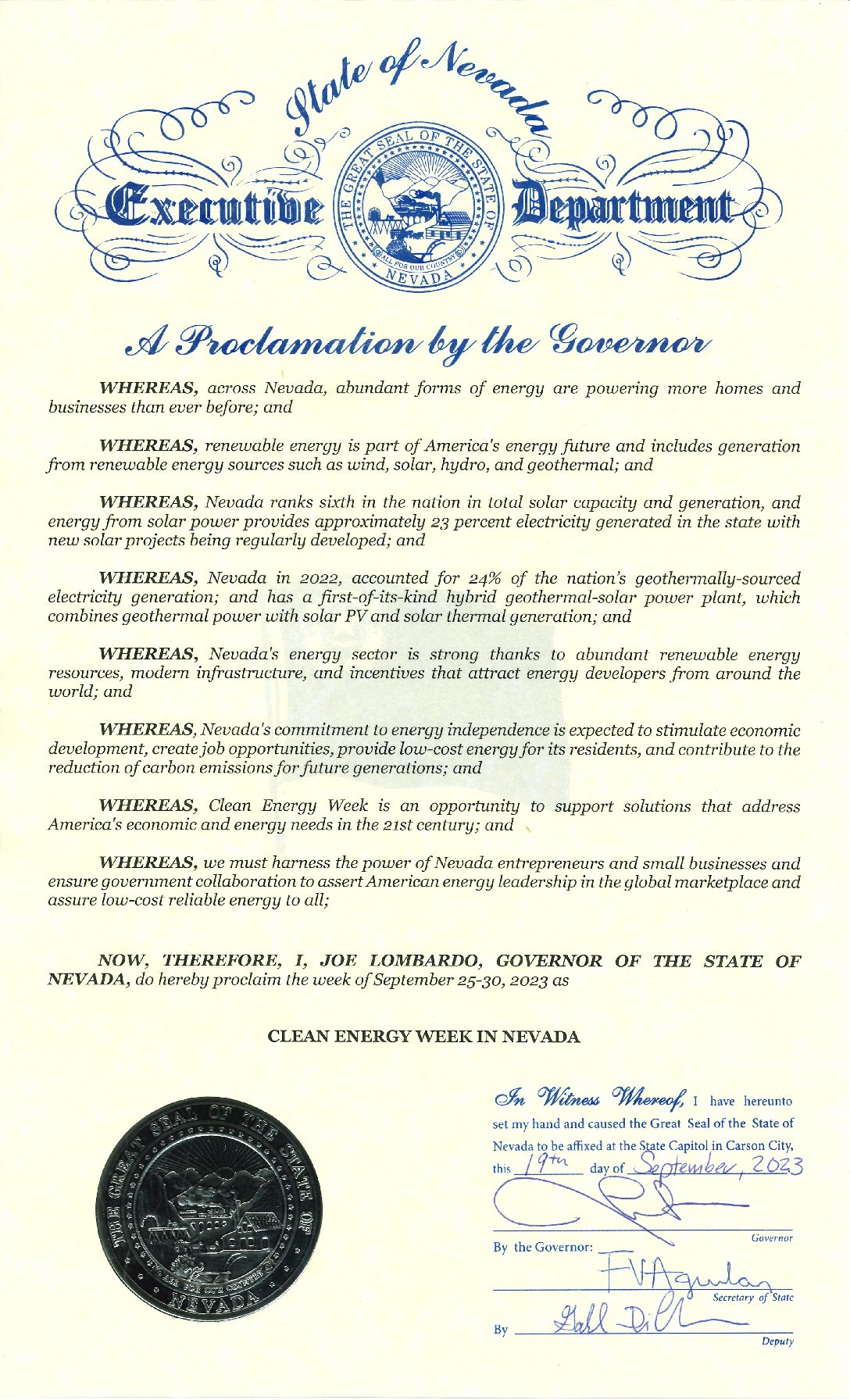
Western Governor’s in AZ, CO, ID, NM, NV, and UT all signed proclamations this week highlighting their states’ unique and important roles in driving energy innovation and increasing clean domestic energy production.

Fervo Energy Cape Station Groundbreaking

Earlier this month TWW had the opportunity to attend the groundbreaking of Fervo Energy's Cape Station Project in Beaver County, UT.  Once completed the project will be the largest enhanced geothermal project in the world producing over 400 MW of firm 24/7 renewable electricity.

Cape Station will provide roughly 6,600 jobs during construction and 160 full-time jobs throughout its operations, generating more than $437 million in earned wages. Federal, state, and local officials joined Fervo to celebrate this milestone.

Utah is home to immense geothermal potential. Researchers estimate that the southwest portion of the state contains more than 10 GW of high-quality geothermal reserves. Additionally, Cape Station will benefit from the Department of Energy’s Frontier Observatory for Research in Geothermal Energy (FORGE). Over the last six years, FORGE has completed groundbreaking research that has dramatically advanced geothermal development in the region.

Utah Governor Spencer Cox said, “Utah is no stranger to energy leadership. For decades, oil and gas workers in the Uinta Basin have produced energy vital to the growth of not just our state but our nation. Geothermal innovations like those pioneered by Fervo will play a critical role in extending Utah’s energy leadership for generations to come.”

Earlier this year, Fervo announced breakthrough result of its commercial pilot project, Project Red in Winnemucca, NV. Using drilling technology honed in the oil and gas industry, Fervo performed a 30 day well test, the results of which established Project Red as the most productive enhanced geothermal system in history.

“Beaver County, Utah is the perfect place to deploy our next-generation geothermal technology,” said Tim Latimer, Fervo Energy CEO and Co-Founder. “The warmth and hospitality we have experienced from the communities of Milford and Beaver have allowed us to embark on a clean energy journey none of us could have imagined just a few years ago. Thanks to cutting edge research and data collection from FORGE, Fervo can accelerate the production of the region’s geothermal resources.”

Cape Station is now positioned to channel $1.1 billion to supply chains and local businesses, catalyzing critical growth in the county. Fervo is working with experienced oil and gas companies, including Helmerich & Payne, Devon Energy, and Liberty Energy.

Solar panels above crops and livestock is a win for energy and agriculture

This piece from TWW’s Greg Brophy was originally published by the Fence Post on September 22, 2023 and can be accessed here.


Building solar panels above crops and livestock is a win for energy and agriculture

News NEWS | Sep 22, 2023

By Greg Brophy

Out of small things, big things can grow.

That’s true for businesses, technological advances and many other human endeavors. Speaking as a corn and melon farmer from Colorado’s Eastern Plains, I can say it’s also true about agriculture — literally so. Between planting season and harvest season, the speed of growth in a good crop year is truly amazing. 

I have similarly high hopes for a new initiative in Colorado that combines farming with the generation of electricity from photovoltaic solar panels. The practice of co-locating crops, livestock and solar panels — better known as agrivoltaics — is not widespread just yet. But it’s promising and builds on generations of complementary energy production in farming and ranching communities — from wind turbines to biofuels, renewable natural gas to traditional hydrocarbons.

The first and most obvious benefit of agrivoltaics is the revenue that farmers and ranchers receive from the solar panels themselves, just as they would from any other source of energy production on their land.

But there are other benefits too. When solar panels are sited correctly and boosted several feet above the ground, the shade they provide creates different growing conditions — or microclimates — on a farm or a ranch. This allows for a wider range of crops and livestock to be raised, giving the landowner more options for boosting the productivity of their land.

The shade also reduces the amount of water needed for irrigation, and in return, the vegetation underneath the solar panels keeps those panels cooler, boosting operational efficiency and the amount of electricity they produce.

I saw this first-hand on a recent tour of Jack’s Solar Garden, the largest active research site for agrivoltaics in the country, located just south of Longmont, Colo. More than 15 crop varieties are being grown there under the partial shade of more than 3,000 solar panels.

It’s an elegant solution that holds the promise of diffusing land-use conflicts over renewable energy before they even start.

The U.S. Department of Energy has estimated that solar panels may need as much as 10.3 million acres of land by 2050, depending on how much the sector grows over the coming decades. That’s more than twice the size of the state of New Jersey, and it will require large-scale solar arrays to be built where there are wide open spaces.

Some of that development will take place — and is already taking place — in rural communities where agriculture isn’t just an economic driver, it’s a source of tremendous pride.

While the wind industry was quick to observe this, it’s taken longer for some in the solar industry to realize that farmers and ranchers don’t want to trade agricultural land for energy-producing land. They want to use their land for both agriculture and energy, not just for business reasons, but for personal reasons, too.

The potential for agrivoltaics to offer the best of both worlds has caught the attention of Colorado lawmakers. Earlier this year, a bipartisan bill — SB23-092 — passed the state legislature with overwhelming support.

Sen. Cleave Simpson and Rep. Matt Soper, both Republicans, worked with two Democrats, Sen. Chris Hansen and Rep. Karen McCormick, to get the bill through what was otherwise a very contentious legislative session. The fact that Simpson is a farmer and rancher and McCormick is a veterinarian probably helped them explain why the concept of agrivoltaics holds such promise.  

The bill’s provisions on agrivoltaics are quite modest, which as a fiscal conservative, strikes me as a good idea. The legislation authorizes $500,000 in state grants to support other small-scale agrivoltaic projects to see if the success of Jack’s Solar Garden can be repeated elsewhere.

I’m sure it will be, even though it may take years before this kind of innovation becomes standard across much bigger farming and ranching operations. It will take some time for agrivoltaics to gain familiarity and trust among farmers and ranchers, and what works on a small scale may need some modification and improvement before it can work on a much larger scale.

But the potential of this emerging agricultural and energy partnership is undeniable. Even if it starts small, I have a feeling it will eventually grow into something much, much bigger.

Brophy is a former state senator and farmer from Wray, Colo. He is the Colorado director for The Western Way.

Conservatives aren’t against climate action. These Utahns are proving it

This piece from TWW’s Steve Handy first ran on September 19, 2023 in the Deseret News and can be accessed here.

Conservatives aren’t against climate action. These Utahns are proving it

The real debate over greenhouse gases and climate change isn’t whether we should be reducing emissions — it’s how we go about reducing emissions

By Steve Handy

Sept 19, 2023, 1:00pm MDT

Political pundits and reporters in the national media have a habit of dividing up the country into one of two groups: Those who are “for” something and those who are “against” it.

In the case of energy and climate, the national media portrays progressive politicians and activist groups as being “for” reducing greenhouse gas emissions, while conservatives are wholeheartedly “against” it.

That kind of all-or-nothing media coverage does not serve our country well, because the real debate over greenhouse gases and climate change isn’t whether we should be reducing emissions — it’s how we go about reducing emissions. 

Once you’ve had that reality check, it quickly becomes clear that conservatives have some of the best ideas about how to reduce emissions without sacrificing all the other things we care about as a country.

For this reason, it was heartening to attend the second annual Conservative Climate Summit at Utah Valley University earlier this month. Hosted by Republican Utah Rep. John Curtis, the event brought together some of the leading conservative voices in the nation on energy and environmental issues.

Curtis is the chairman of the Conservative Climate Caucus, which is on a mission to develop and promote market-driven solutions to environmental challenges, rather than big-government schemes which carry costs that outweigh any of the benefits.

The leaders who joined Curtis at this year’s conference included Rep. Bruce Westerman, an Arkansas Republican who chairs the House Committee on Natural Resources; Rep. Marianette Miller-Meeks, an Iowa Republican and vice chair of the Conservative Climate Caucus; and Wyoming’s Republican Gov. Mark Gordon.

Former Rep. Chris Stewart and the Republican nominee who is running for the seat he recently retired from, Celeste Maloy, also took part.

On the sidelines of this year’s summit, Curtis explained that left-wing environmental policies in Europe are a cautionary tale. Those policies largely prevented fracking for oil and natural gas and curtailed Europe’s ability to generate clean electricity with nuclear power.

The result: sky-high energy prices and a dangerous dependence on Russia for imported natural gas. The terrible cost of anti-fracking, anti-nuclear policies was driven home by the energy shocks that Europe experienced after Russia’s invasion of Ukraine. In fact, had the U.S. not come to Europe’s rescue with a massive increase in shipments of liquefied natural gas, there could have been a major humanitarian disaster across the entire continent last winter.

“Europe went down a path (and) they made some really bad decisions,” Curtis said in an interview with the Sutherland Institute.

“If (conservatives) are not at the table pointing out the fallacy of those decisions, (America) will likely make the same mistakes.” 

The key for conservatives: realizing that there are major environmental benefits to other policy positions they take.

For example: Dependence on Russian gas wasn’t just a security problem for Europe. It was a major climate problem, because Russia’s decrepit oil and gas infrastructure was a major source of methane emissions, one of the most powerful greenhouse gases. 

Switching to U.S. natural gas was a major win for the climate. Because our oil and gas industry is not controlled by the state, it operates in a competitive market, it’s better capitalized, and it can afford the kind of environmental controls that dramatically limit methane emissions.

So, conservatives who supported the increase in U.S. energy exports to Europe for geopolitical and trade reasons may not realize that their position was also good for the climate, too. 

“The same policy that is best for our environment is the same policy that is also best for national security, energy independence, agriculture and our economy,” Curtis told attendees of the conservative climate summit.

Westerman, chairman of the natural resources committee, told the summit about another example of conservative ideas having major environmental benefits.

Cutting red tape and taking on the bureaucracy are cherished conservative ideals. But even left-of-center politicians and interest groups believe we need to speed up the permitting process for energy projects of all kinds, including solar and wind.

Not only that, the nation needs a faster permitting process for the mining projects needed to produce the materials that go into solar panels and wind turbines, not to mention electric cars. 

That’s why the debt-ceiling compromise bill passed earlier this year included major permitting reforms that House Republicans championed before anyone else, Westerman told the summit.

“It’s often implied, ‘Well, you’re a conservative, therefore you don’t care about the environment, you don’t care about climate,’” Stewart, who retired in mid-September as the representative for Utah’s 2nd Congressional District, told the summit. “Well, what nonsense.”

In private company, I might use a stronger word than “nonsense,” but he’s absolutely right. Unwinding these false and unhelpful stereotypes will take time, but thanks to Utah leaders like Curtis, it is finally happening.   

Steve Handy is a former Utah legislator and Utah state director for The Western Way.

Agrivoltaics Benefits Farmers and Rural Communities

This month TWW, local officials, and Colorado agriculture leaders had the opportunity to tour Jack’s Solar Garden in Longmont, CO.  Jack’s Solar Garden is a pioneer in agrivoltaics, which is the co-locating of solar panels with beneficial agriculture. Jack’s is the largest commercial research site for agrivoltaics in the United States.  Jack’s partners with the National Renewable Energy LaboratoryColorado State University, and the University of Arizona to conduct a variety of research on the feasibility and best practices for agrivoltaics and then disseminates that information to farmers interested in adopting the practice.  With land usage for solar production expected to increase rapidly over the next several decades, especially in rural communities, agrivoltaics could allow for farmers to use their land for both energy and food production. 

Jack’s is showing that agrivoltaics can provide a variety of benefits to farmers and landowners including water conservation, higher crop yields, improved soil quality, crop protection and increased revenue from land with dual uses.   Research is showing that the solar panels can create microclimates under the panels which support increased crop yields for certain plants and use less water, with some crops needing almost half the traditional amount of water required. 

Learn more in this video below from Byron Kominek, the owner and founder of Jack’s Solar Garden.

Conservative Energy Network Meets in Iowa

Earlier this month, TWW joined members of conservative free market organizations from across the country at the Conservative Energy Network’s annual gathering in Des Moines, Iowa from August 14-17th. The network heard from technical experts, industry representatives, and policymakers. Notable speakers included U.S. Senator Chuck Grassley (R-Iowa) and Congressman Zach Nunn (IA-3) as well as Iowa State Senators Mike Klimesh and Waylon Brown, and State Representatives Brian Lohse and Shannon Lundgren.

John Szoka, CEO of the Conservative Energy Network noted:

“CEN’s annual Conservative Conclave represents a gathering of conservatives who are leading the charge in shaping America’s energy future. We are stronger when we come together to learn from each other and build relationships that cross state lines.”

Senator Chuck Grassley with TWW’s Steve Handy and David Oman from the Iowa Conservative Energy Forum

Economic benefits start to flow from power line project after 15-year delay

The opinion piece below from TWW’s Greg Brophy originally ran in The Daily Sentinel on August 8, 2023 and can be accessed here.

Economic benefits start to flow from power line project after 15-year delay

Aug 8, 2023

By GREG BROPHY

Much has been said about the federal permitting reforms that were included in the bipartisan deal to raise the federal debt ceiling and avoid the threat of a first-ever default on the national debt.

Those reforms, originally championed by House Republicans and eventually supported by the Biden White House, will make the federal permitting process for newly proposed energy and infrastructure projects faster and more focused.

But if the Biden administration truly supports the cause of permitting reform, it will also have to move quickly on permitting decisions for existing proposals that have been stuck in the process for years.

Every day those projects continue to be held up under the old rules is another day that mostly rural communities will be denied the considerable economic benefits tied to the construction and operation of those projects.

Consider the case of the TransWest Express Transmission Project, which will connect wind farms in Wyoming with major urban centers on the West Coast.

Despite the clear benefits of the 732-mile transmission line, it was held up for 15 years in a textbook example of how broken the federal permitting process had become.

At one stage, different parts of the federal bureaucracy were actively working against each other on opposite sides of the debate over whether to build the project or whether to block it. Your tax dollars at work, as they say.

Earlier this year, sanity prevailed at last, and the project got the final approvals needed from the federal government. Construction started in June, and the groundbreaking brought together officials from across the spectrum: Republicans and Democrats, business groups and labor unions.

The event brought into focus something that was almost completely forgotten during the interminably long permitting process: The economic benefits from building and operating the power line itself.

TransWest Express is a $2.9 billion project, and in rural America, that’s a big deal. Not just because of the jobs tied to building and operating the project, but because of the local tax revenues a $2.9 billion capital project is able to generate.

An analysis prepared by TransWest estimates $891 million in property taxes will be paid across four states — Wyoming, Colorado, Utah and Nevada — during the long-term life of this project.

A further $113 million in sales taxes will be generated as well, according to the TransWest analysis. Taken together, the property and sales taxes from this landmark transmission line project will total more than $1 billion over 50 years.

On average, that’s more than $20 million per year going into local services: From schools to law enforcement, fire protection to parks and recreation, public libraries to public hospitals.

Many of these local services in the rural West operate with budgets measured in the hundreds of thousands of dollars per year, so an extra $20 million per year on average is a big deal.

But that’s just scratching the surface. The construction of a major new transmission line will spur investment in new power generation projects that will connect to that transmission line. New solar arrays, wind farms, advanced nuclear reactors and other forms of electricity generation will generate further economic activity, including jobs and tax revenues.

These projects can make a huge difference in rural America. A study conducted by The Western Way, where I serve as Colorado state director, examined the upside for communities that see major new investments in renewable energy.

The study, which focused on the Eastern Plains of Colorado, found that funding for local services in a community with major renewable energy investments grew twice as fast as a neighboring community with little to no renewable energy investments.

“The construction phase boosts the Main Street economy and wind farms generate a lot of property tax revenue, which helps school districts, fire districts, county government, city government and other local services in our community,” Kit Carson County Commissioner Dave Hornung told the authors of the study.

The lesson from the TransWest Express case is that permitting delays don’t just hurt the companies that want to build infrastructure projects. Permitting delays also hurt local communities by denying them the economic benefits — including badly needed tax revenues — that flow from those projects.

Washington, D.C. bureaucrats don’t need to wait for a new round of permits, submitted under new rules, to make things better. They can start today by finding projects that have been needlessly delayed and give them the green light as soon as possible.

Greg Brophy is a farmer and former state senator from Wray. He is currently the Colorado Director for The Western Way.

A better way to store energy for the West’s power grid

This opinion piece from TWW’s Greg Brophy originally ran in Colorado Politics on July 12, 2023 and can be accessed here.


Over the next decade, rural communities in Western states have a huge opportunity to increase the amount of energy they provide to major urban centers. By making the most of this opportunity, we can strengthen our communities with more investment, jobs and funding for critical services.

That’s true across all energy technologies, including oil and gas, hydrogen, carbon capture and advanced nuclear. But it’s especially true for renewable sources of energy like wind farms and solar arrays, which have found a natural home on the eastern plains of Colorado, where I’m from, and in many other rural areas across the western United States.

We have some barriers to overcome, however. The most talked about is the need for more long-distance power transmission lines to move all that electricity from the farming and ranching communities where it’s produced to the cities and suburbs where it’s consumed.

But expanding the amount of energy storage available to power grid operators is another major challenge that deserves more attention.

With more storage, electricity generated when the wind is blowing and the sun is shining doesn’t have to be used right away — it can be used at any hour of the day or night, regardless of weather conditions.

That’s good for the reliability of the power grid, but it’s also good for rural communities, because energy storage effectively grows the market for the electricity they produce.

For this reason, lawmakers and power grid regulators need to look at all the viable energy storage technologies — not just bigger versions of the lithium-ion batteries that currently power our phones, laptops and even electric cars.

One of the most promising of those technologies is called pumped hydro storage. It’s not a new technology, and despite all the attention given to lithium-ion batteries, pumped hydro storage provides more than 90% of the energy storage available on the U.S. power grid today.

According to the Pacific Northwest National Laboratory (PNNL), pumped hydro storage is “a mature technology that includes pumping water from a lower reservoir to a higher one where it is stored until needed.”

When electricity from renewable sources is used to run those pumps, that renewable energy is stored. When the water is released, “it flows back down through a turbine and generates electricity,” according to PNNL.

Effectively, pumped hydro storage functions as a water-based battery, using technology that’s been around a lot longer than lithium-ion battery technology.

For this reason, pumped hydro is one of the lowest-cost technologies for energy storage. According to PNNL, once built, a pumped hydro storage facility can function for 60 years or more without the same kind of maintenance and repair costs that apply to electrochemical battery technologies like lithium-ion.

Just like the batteries in your cellphone, laptop or electric car must be reconditioned or replaced over time, so do the much larger batteries used to store electricity for the power grid — and that adds cost.

That’s not the case for pumped hydro storage. “It doesn’t degrade no matter how much you cycle it up and down,” Matthew Shapiro, the CEO of rPlus Hydro, said in an interview with The Western Way.

With 15 pumped storage projects in development across the U.S., officials at rPlus Hydro say their technology isn’t meant to directly compete with electrochemical batteries. In fact, rPlus Hydro’s parent company — rPlus Energies — builds solar arrays that are paired with battery-based storage systems.

It turns out lithium-ion batteries are good at storing and discharging electricity in short bursts, while pumped storage hydro can provide many more hours of backup power to the grid.

“It’s not an ‘us’ versus ‘them’ dynamic,” Shapiro said. “Batteries are good for short durations of between two and four hours. Pumped storage typically works well over an eight-hour duration.”

Another cost-saving feature: pumped hydro storage doesn’t rely on the same supply chain as consumer electronics and electric cars. Though there are moves to reform project permitting and build more mines in America, the global supply of critical minerals needed for batteries and other low-carbon energy technologies is currently dominated by foreign nations, especially China.

Until that changes, “there’s a lot of concern about battery supply chains, especially with the growing appetite for electric vehicles in the automotive sector,” Shapiro said.

The lesson for lawmakers and regulators is clear: policies to expand energy storage can’t be solely focused on lithium-ion or other kinds of electrochemical battery technologies.

Reforms to speed up the permitting process and incentivize the construction of energy storage facilities must be applied broadly to include established technologies, including pumped hydro storage.

Chasing new technologies is all well and good. But for the sake of our energy security and the rural communities that make that security possible, we must not lose sight of the technologies we already have.

Greg Brophy, from Wray, is a farmer and former state senator. He is the Colorado director of The Western Way.

Record Geothermal Production at Fervo Energy’s Nevada Pilot Project

Today, geothermal energy startup Fervo Energy announced that it had successfully completed a well test at it’s Project Red pilot plant in Winnemucca, Nevada.  The successful test means that Fervo Energy is the first company to successfully drill a horizontal well pair for commercial geothermal production, achieving lateral lengths of 3,250 feet, reaching a temperature of 376 °F, and proving controlled flow through rigorous tracer testing.  

“By applying drilling technology from the oil and gas industry, we have proven that we can produce 24/7 carbon-free energy resources in new geographies across the world. The incredible results we share today are the product of many years of dedicated work and commitment from Fervo employees and industry partners, especially Google,” said Tim Latimer, Fervo Energy CEO and Co-Founder.

The successful well test confirms the commercial viability of Fervo’s drilling technology and establishes Project Red as the most productive enhanced geothermal system in history. The 30-day well test, a standard for geothermal, achieved a flowrate of 63 liters per second at high temperature that enables 3.5 MW of electric production, setting new records for both flow and power output from an enhanced geothermal system.

Fervo noted that the data collected during pilot will enable rapid advancement in geothermal deployment, with Fervo’s next horizontal well pair planned to achieve more than double the power output of the pilot design.

Fervo’s results from Project Red support the findings of the DOE Enhanced Geothermal Earthshot and show that geothermal energy could supply over 20% of U.S. power needs and compliment wind and solar to reach a fully decarbonized grid. Fervo’s drilling and well test results pave the way for the U.S. to meet this goal ahead of schedule; with Fervo’s breakthrough, no technological barriers to geothermal deployment remain.

Fervo Energy CEO Tim Latimer detailed the accomplishment and the work that led up to it via Twitter:

Western Govs Release Geothermal Energy Report

The Western Governors’ Association released a new report, “The Heat Beneath Our Feet” which explores the opportunities to accelerate geothermal energy development and deployment across the West. Colorado Governor Jared Polis, the Chair of Western Governors’ Association focused on geothermal energy during his chairmanship over the last year. The report is a culmination of four workshops and six tours with input from the geothermal industry, policy makers, and other stakeholders.

The report’s recommendations to advance geothermal energy include:

  • Improve resource assessment and data collection: Increasing federal funding for resource assessments, coordinating efforts to target areas with the greatest potential, improving the federal repository of data relevant to geothermal development, and leveraging data from the oil and gas industry, as well as new technology, will increase our understanding of subsurface resources and foster additional geothermal development.

  • Mitigate risk in drilling and exploration: Risk and uncertainty contribute to relatively high up-front costs for geothermal development. Those costs can be abated by continuing federal investment to reduce uncertainty in geothermal exploration, exploring models to help developers secure financing for exploratory drilling and mitigate drilling risk, and extending existing tax incentives for the oil and gas industry to include geothermal development. • Optimize permitting and improve regulatory certainty: Permitting timelines can also be prohibitive for geothermal development. Lengthy delays can be mitigated by providing tools and resources to help stakeholders navigate the geothermal development process, increasing agency capacity for leasing and permitting, developing streamlined processes and categorical exclusions for geothermal leasing on par with other energy categories, expanding oil and gas exploration regulatory efficiencies to geothermal development, and collaborating with tribes and communities prior to and during project development. •

  • Expand funding opportunities: U.S. Department of Energy (DOE) funding for demonstration projects and the Geothermal Technologies Office (GTO) should be increased. Investment in energy transition communities should be encouraged.

  • Implement incentives for consumer adoption: Expedite the deployment of tax incentives, rebates, and enduser applications to spur the adoption of geothermal heating and cooling.

  • Develop workforce and contractor ecosystem: Geothermal energy can generate good jobs and create opportunities for workers and communities affected by the energy transition. Workforce development in the geothermal industry should be supported, including through the development of training and certification programs.

  • Increase awareness and education to develop geothermal markets: Develop guidance for policymakers, regulators, and utilities to better promote geothermal energy.

How environmental groups fuel forest fires

This piece from TWW’s John Karakoulakis originally ran in the Washington Examiner on June 28, 2023 and can be accessed here.

The Rocky Mountain West has some of the most beautiful forests in the world. Whether you enjoy hiking, fishing, or simply admiring the views from afar, we’re lucky to have these majestic natural resources in our backyard.

But living in close connection with these forests also takes real work. Public forests , for example, are managed by dedicated state and federal agencies staffed with wildlife biologists, soil scientists, hydrologists, and other professionals.

Too often, their work is made much more difficult — if not impossible — by far-left environmental groups who use strategic lawsuits to prevent forest management activities from taking place. It’s time that elected officials in the nation’s capital put an end to these abusive lawsuits or, at a minimum, roll back some of the worst impacts.

It isn’t just about helping people, who radical environmentalists view as irredeemably bad. It’s also about helping the wildlife species that these groups claim they are trying to protect.

Here’s why: For forest managers, a big part of their job is keeping the ecosystem healthy while also making sure it’s safe for people to live near and visit. That job is harder than it sounds, especially in the West, because people have understandably chosen to limit the natural role that fire plays in maintaining balanced forest ecosystems.

Without natural fires, large amounts of undergrowth can build up. Over time, the stockpile of fuel grows to dangerous levels, and when there is a fire, it’s much larger and more damaging than it should be.

That isn’t just bad for the people living in nearby communities; it’s also bad for wildlife. Ecologists have found that when forests grow too tall and too thick due to decades of fire suppression, there aren’t enough smaller, younger plants to provide the kind of habitat that many species need.

“In today’s situation, if you look at these big panoramic landscapes, what you see is an incredibly lower level of diversity, where the forest has all grown up and blended,” Paul Hessburg, a research landscape ecologist with the U.S. Forest Service, told Oregon Public Broadcasting back in 2018. “There are some critters still making a living in that landscape, but it has nowhere near the variety of the former landscape before it was homogenized.”

Small-scale, controlled burns are one tool that forest managers can use to mimic the role of natural fires. But mechanical thinning of the undergrowth, using everything from hand tools to rakes to chainsaws to wood chippers, is also a must, according to the U.S. Forest Service.

Piling up brush, thinning dense stands of trees, and pruning lower branches are some of the ways forest managers reduce the risk of catastrophic fires and encourage the kind of new growth and restoration that benefits wildlife.

But a faction of the environmental movement finds this kind of human activity in forests to be unacceptable, and for decades, these activists have been waging war against forest managers in the courts.

Perhaps the worst example is the 2015 victory of the Cottonwood Environmental Law Center in front of the ultraliberal 9th Circuit Court of Appeals in San Francisco.

The decision allowed environmental groups to use the Endangered Species Act to derail existing forest management plans by forcing the federal government to go back and repeat years of consultation and desk work on those plans.

The Obama and Trump administrations worked with Congress to freeze the effect of the so-called Cottonwood decision, but that freeze recently expired. Today, there are 87 different forest management plans that could be brought to a halt by Cottonwood-style lawsuits, the U.S. Forest Service has warned .

On federal land alone, there is already an 80 million-acre backlog of forest ecosystems that need restoration work. The wildfire threat posed by this backlog has been called a “ crisis ” by the Biden administration, which is attempting to fast-track forest-thinning projects over the next decade.

But the Biden forest plan and other forest management proposals to reduce the backlog are now clouded in uncertainty because of the renewed threat of legal action.

Sen. Steve Daines (R-MT) is leading a bipartisan coalition of lawmakers to fix this problem. “An immediate resolution to this decision is vital to allow land managers and wildlife biologists to follow the best available science to improve the health of our forests, reduce the risk of severe wildfires, advance wildlife habitat projects, and support good paying timber jobs,” Daines and his fellow lawmakers told the Biden administration earlier this year.

It’s hard to fathom how an idea with this much bipartisan support still struggles to get traction inside the Beltway. Regardless, it’s time for real leaders in both parties to come up with a permanent legislative fix to this problem.

For communities facing the growing threat of catastrophic wildfires, it truly is a matter of life and death.

John Karakoulakis is director of The Western Way, a nonprofit organization focused on free market solutions to Western U.S. conservation issues.

Why debt deal’s permitting reforms are a win for rural economies

This opinion piece from TWW’s Steve Handy originally ran in the Deseret News on June 19, 2023 and can be accessed here.

Less than six months ago, a new conservative majority in the U.S. House of Representatives put an end to one-party Democratic rule in the nation’s capital.

After the left-wing legislative and regulatory onslaught that characterized the first two years of President Joe Biden’s term, the rise of Republican Speaker Kevin McCarthy and the GOP Conference was a badly needed reprieve for center-right voters.

Frankly, if all the Republican House majority accomplished was stopping bad bills from becoming bad laws, that would have been enough. But the recent deal reached between McCarthy and Biden over the nation’s debt ceiling also included a massive win for conservative, rural communities — especially those in Western states.

The debt ceiling bill also includes major reforms to the federal permitting process for energy projects, which have been a major source of economic growth for farming and ranching communities in the American West.

This growth has been artificially constrained, however, due to a federal permitting process that has grown unwieldy and open to political manipulation by environmental activists and other opposition groups.

Transmission lines, mining projects, oil and natural gas pipelines and many other energy infrastructure projects have been tied up in knots because of the problematic federal permitting process. As a result, rural communities have been limited in the amount of energy and energy-related products they can make and sell to urban centers and overseas buyers.

But the Fiscal Responsibility Act will tip the scales back towards a balanced, functional permitting system that provides strong environmental protections without limiting the economic potential of rural America, and especially Western states, where the federal government is the biggest landowner. 

In particular, the Fiscal Responsibility Act brings some badly needed commonsense to permitting reviews under the National Environmental Policy Act, which opposition groups have learned how to manipulate to their advantage.

Instead of using far-fetched hypotheticals to block or delay projects, federal permitting reviews must now be focused on “reasonably foreseeable environmental effects” and “a reasonable range of alternatives.”

Environmental impact statements will now have to be completed within two years, instead of being dragged out indefinitely. Not only that, there will be page limits on completed environmental impact statements, which will also help to keep regulators focused on the real issues at hand.

The Fiscal Responsibility Act also requires a single agency to lead the environmental review of a permit application, instead of having multiple arms of the federal government conducting duplicative and sometimes contradictory reviews.

This will help prevent the kind of bureaucratic battles that can add years to the federal permitting process. In one infamous case, a transmission line project that would connect wind farms in Wyoming with big cities in California was stuck in the permitting review process for 15 years, until it was finally approved in April.  

The permitting reforms in the Fiscal Responsibility Act have stayed mostly “under the radar” but they are still hugely important, Republican Utah Congressman Blake Moore said.

The National Environmental Policy Act hasn’t been meaningfully reformed in 40 years, and the improvements that Republicans fought for and won will “greenlight more American energy and infrastructure projects without crippling restrictions and procedural hurdles,” Moore said

These projects will build stronger connections between the predominantly rural communities where energy is produced and the domestic and international markets where that energy is consumed.

Simply put, the more energy we can produce and sell, the more prosperous our communities will be — and the Fiscal Responsibility Act will help make that happen.   

Steve Handy is a former state legislator and the Utah director for The Western Way, an organization focused on market-competitive solutions to environmental and conservation challenges. He also served as a communications consultant for the recent Western States Hydrogen Hub application.  

TransWest Express Project Kicks Off Construction

The TransWest Express Transmission Project began construction on June 20, 2023. The groundbreaking in Carbon County, Wyoming was attended by Wyoming Governor Mark Gordon, U.S. Secretary of Energy Jennifer Granholm, U.S. Secretary of the Interior Deb Haaland, Utah Office of Energy Director Gregory Todd, Nevada Office of Energy Director Dwayne McClinton and others.

The 732-mile HVDC and HVAC TWE Project will provide important new bulk transmission capacity to benefit the entire West. The TWE Project will interconnect with the PacifiCorp system in Wyoming, with the Los Angeles Department of Water & Power and Intermountain Power systems in Utah, with the NV Energy system in Nevada, and with the California Independent System Operator.

“The TWE Project’s successful development represents recognition by stakeholders of all kinds and at all levels that collaborating to build a stronger power grid is vital to build a stronger nation,” said Bill Miller, president and CEO of TransWest Express LLC. “We deeply appreciate the support we’ve received from so many people along the way. We are thankful for everyone who celebrated this milestone with us today. Now, we look forward and are focused on assuring the TWE Project’s successful construction.”

The TransWest project will result in significant economic benefits to western states and rural counties. TWE estimates the following benefits from the $2.9 Billion dollar project investment.

Additionally, TransWest anticipates the purchase and delivery of construction materials, substation equipment and transmission towers will generate about $113.5 million in total sales and use tax revenue.

From left: TransWest COO Roxane Perruso; TransWest CEO Bill Miller; Energy Secretary Jennifer Granholm; Rich Voorberg, Siemens Energy North America President; Gregory Todd, Utah Office of Energy Director; James Lester, Colorado Energy Office Advisor; Interior Secretary Deb Haaland; Wyoming Governor Mark Gordon; Dwyane McClinton, Nevada Office of Energy Director; Maury Galbraith, Colorado Electric Transmission Authority Director; Derek Donley, IUOE Western Region Director; and Jeff Neitzel, IBEW 8th District International Representative. Additional key partners (not pictured) are the team from Barnard Wilson Joint Venture, including Tim Barnard, Chairman, Barnard Construction Co., and Don Wilson, CEO of Wilson Construction.

Congress can speed up America’s push for cleaner energy

This opinion piece from TWW’s Steve Handy originally ran in the Deseret News on June 5, 2023 and can be accessed here.

For more than a decade, America has been moving away from foreign sources of energy to homegrown sources of energy, and from high-carbon fuels to low-carbon fuels.

That’s not because of a big government program — it’s pure economics. The cost of domestically produced natural gas and renewable energy sources like wind and solar plummeted during the 2010s, and so did America’s carbon emissions.

Today, we could be producing much more homegrown energy and cutting carbon emissions at an even faster pace. But ironically, federal environmental regulations and left-wing green groups are slowing things down.

That’s because to create new sources of energy, you have to build things. Like transmission lines to move electricity from wind farms in the countryside to homes and businesses in the city. Or pipelines to move natural gas from where it’s produced to homes, businesses, factories, power plants and export terminals. Or mines that dig up the metals needed to make grid-scale batteries and electric cars.   

And yet, thanks to decades of lobbying and lawsuits, the federal permitting system for large construction projects in the U.S. has become almost unworkable.

It’s so bad that even far-left environmental activist Bill McKibben — godfather of the “keep it in the ground” movement — can admit that things have gone too far.

“I’m an environmentalist, which means I’ve got some practice in saying no,” McKibben recently wrote in Mother Jones magazine. “But we’re at a hinge moment now, when solving our biggest problems … means we need to say yes to some things.” McKibben’s article was even headlined: “Yes In Our Backyards.”

Actions, however, speak louder than words — which is why new conservative leadership in the U.S. House of Representatives is a big deal if you want to see America start to build things again.

In late March, the House passed a major permitting reform bill: The Lower Energy Costs Act. The bill, which is now before the Senate, streamlines and simplifies 1970s-era permitting procedures so that project developers can get a clear yes or no answer on whether construction can proceed much faster than is possible today.

In the decades since the National Environmental Policy Act and other landmark environmental statutes were passed, environmental activists and overzealous regulators have learned how to slow down the permitting review process as much as possible, adding years of delay, expense and uncertainty.

According to Utah Congressman John Curtis — chairman of the House Conservative Climate Caucus — the bill will support the development of clean energy technologies, improve energy efficiency, and promote energy independence by improving the permitting process for all sources, from wind and solar to oil and natural gas. 

“Republicans care deeply about this Earth, emission reductions, affordable energy, and energy independence, all of which are achieved by this bill,” Curtis said after the bill cleared the House in a bipartisan vote

So what happens next? One possibility is that leaders in the Senate decide to do nothing and keep the nation’s broken permitting system in place for the benefit of a small number of activist groups. That would expose these groups and their allies in Congress as hypocrites, since they claim to support the move away from foreign sources of energy to homegrown sources of energy, and from high-carbon fuels to low-carbon fuels.

Hopefully, however, common sense will prevail. The leading champion for permitting reform in the Senate is Sen. Joe Manchin of West Virginia.

Last year, Manchin spent months developing his own proposal for streamlining the permitting process, which wouldn’t remove any environmental safeguards, but would speed up the time it takes to get a final answer from regulators or the courts.

“The United States of America is more litigious than any nation on Earth,” Manchin said late last year when his proposal was blocked in the Senate. “It takes longer to do anything here.” 

Hopefully, leaders in Congress — especially members of our own delegation from Utah — now have a chance to restart the debate over permitting reform.

When members from across the political spectrum can see there’s a problem, commonsense solutions can be found — and must be found. 

If we hope to lower energy prices and lower emissions at the same time, there’s no way around it; we have to start building in America again.   

Steve Handy is a former state legislator and the Utah director for The Western Way, an organization focused on market-competitive solutions to environmental and conservation challenges.

UT Opportunities in Energy Innovation

Steve Handy, Utah’s Director for The Western Way, recently joined Utah leaders from industry, academia, government and the non-profit sector at a luncheon with Representative Blake Moore, a Republican, who represents Utah’s 1st Congressional District to discuss Opportunities in Energy Innovation.

The moderator for the discussion was Brian Steed, Director of Utah State’s Institute for Land, Water, and Air.

Steed framed the discussion as a “listening opportunity” for Congressman Moore to hear from a wide-ranging audience about energy development, management and the advancement of new energy.

Congressman Moore remarked that he is fully vested in an “all of the above approach” to energy and that he wants to find ways to reduce federal regulations in order for innovative approaches in energy development can advance. “From my travels throughout the state and listening to many of you, I know that Utah is an energy powerhouse and has a bright future. I want to be at the table assisting you in any way that I can. My team knows how strongly I feel about energy issues,” said Moore. “The door is always open.”

Western hydrogen hub shows the way forward on energy — and politics too

This opinion piece from TWW’s Steve Handy originally ran in The Salt Lake Tribune on May 16, 2023 and can be accessed here.

Without much fanfare, a group of Western governors last month submitted plans to the federal government to build a major center for hydrogen production in the Rocky Mountain region. The governors of four states — Utah, Wyoming, Colorado and New Mexico — are hoping to secure $1.25 billion in federal funding to help make the proposal, dubbed the Western Interstate Hydrogen Hub, a reality.

This is a bigger story than you might think, for reasons of policy and politics.

Hydrogen may not get the same kind of press as solar panels, wind turbines or electric cars. But ramping up U.S. hydrogen production is critically important for our future energy security.

For example: Hydrogen can be used to power heavy vehicles that don’t perform as well with batteries, such as trucks, buses, trains and even commercial aircraft. Hydrogen can be blended with natural gas to reduce carbon emissions from power plants, factories and even residential sources like furnaces and hot-water heaters.

Hydrogen can also be stored and used to generate electricity or heat at any time of the day or night — what power grid operators call a “dispatchable” energy source. This can provide another option besides natural gas-fired power plants and large-scale batteries for backing up renewables like wind and solar.

So positioning Utah, Wyoming, Colorado and New Mexico as a major hub of hydrogen production — a fuel with so many uses and markets all over the world — is a huge step in the right direction from an economic point of view.

Today, most U.S. hydrogen is made from natural gas in a process that releases carbon emissions into the atmosphere. So even though hydrogen itself may not have direct carbon emissions when used as a fuel, the indirect emissions from how it is made can’t be ignored.

The Western hydrogen hub will tackle this challenge in three principal ways: First, by capturing and storing the carbon emissions during natural gas-based hydrogen production; second, by developing technologies that can use wood waste and other biomass as an alternative feedstock for hydrogen production; and third, by perfecting a process called electrolysis to produce commercial quantities of hydrogen using only electricity and water.

The $1.25 billion federal grant will be enough to begin the development of eight different hydrogen projects across the four states and generate 26,000 jobs, according to state officials.

This level of technological collaboration is impressive enough. But the political collaboration that underpins the planned hydrogen hub is also remarkable.

For example: After the four states submitted their latest plans to the federal government, Utah Gov. Spencer Cox, a Republican, issued a statement that couldn’t have been more bullish.

“Utah has long advocated for doing things a little differently, and in our state, that little bit of difference has led to a lot of innovation and economic success,” said Gov. Cox. “Our partnership in this four-state application is no different. If the Department of Energy wants to spur innovation in hydrogen as an energy source, this is the place.”

Meanwhile, in neighboring Colorado, a statement from Democratic Gov. Jared Polis also fully embraced proposed hydrogen hub. “The investment in these eight hydrogen projects is a crucial step to achieving shared energy independence goals and my goal of 100% renewable energy in Colorado by 2040,” Polis said.

These two elected officials have vastly different political views and core constituencies, and yet, they are united behind the idea of creating a major new industry — hydrogen production — in our region.

In today’s highly polarized political environment, this is no easy feat. But it’s a welcome development, and one that the Biden administration should consider closely when deciding the fate of the $1.25 billion grant application.

Because these four Western states aren’t just showing the path forward for a critically important new energy source. They’re also presenting a powerful example of what can happen when elected leaders with divergent views are willing to sit down, talk and find a few areas of agreement to work on together.


Steve Handy is a former state legislator and the Utah director for The Western Way, an organization focused on market-competitive solutions to environmental and conservation challenges. He also served as a communications consultant for the recent Western States Hydrogen Hub application.

TWW Urges Congress to Support A Permanent Fix to the "Cottonwood" Decision

The Western Way joined other like minded common sense and free market based conservation groups this week urging Congress to support a permanent fix to the “Cottonwood” decision which would improve forest restoration and reduce the risk of wildfires.

With broad support for a permanent Cottonwood fix and a clear need for immediate action, it’s time for Congress to address this problem. Senator Steve Daines’s Cottonwood proposal (S. 1540) and Representative Matt Rosendale’s Forest Information Reform Act (H.R. 200) would allow forest managers to get back to restoring forests and recovering species.

The Property and Environment Research Center (PERC) details what the “Cottonwood” decision is and why it needs to be fixed:

The 2015 Cottonwood v Forest Service ruling, requires the Forest Service to halt forest restoration projects throughout a forest whenever a new species is listed, critical habitat is designated, or other new information is discovered about a species in that forest. The projects can’t proceed until the Service consults with the Fish and Wildlife Service over whether to change its overarching forest plans, a slow and expensive process. 

Pausing projects to protect vulnerable species may sound reasonable, but the reality is that this is a duplicative and distracting process. The Service already analyzes this new information before proceeding with specific projects, ensuring that no harm can come to species. The additional plan-level analysis is a duplicative bureaucratic obstacle. 

A temporary legislative fix was put in place in 2018, but it expired in March 2023. With Cottonwood left unchecked, Forest Service Deputy Chief Chris French estimates projects could grind to a halt in 87 forest plans across the West. According to French, completing duplicative analysis for all of these forest plans would take “somewhere between 5 and 10 years and tens of millions of dollars.” With an 80-million-acre forest restoration backlog, that’s time and money the Forest Service does not have. 

That’s why this bipartisan congressional action is so welcome. It’s past time Congress establishes a permanent fix for Cottonwood. 

Read more about why a fix for Cottonwood is urgently needed here.

The TransWest Express transmission line is a win for rural communities. Why did approval take 15 years?

This opinion piece by TWW’s Greg Brophy originally ran in UtilityDive on May 16, 2023 and can be accessed here.

One of the biggest economic development opportunities in rural America is supporting the expansion of new electricity sources.

Whether you’re talking about wind farms, solar arrays, advanced nuclear power plants or large-scale batteries, rural communities are a natural home for these technologies — especially the rural communities of the West.

As a result, we’ve seen a wave of investment in electricity generation — especially wind and solar — across rural America during the past 20 years. But we haven’t reached our potential and there’s plenty of room left to grow. 

What’s holding rural America back? It’s a lack of transmission lines to move electricity from states like Colorado and Wyoming, where it’s generated, to states like Nevada and California, where it’s consumed.

Recently, however, there was some good news on this front: The federal approval of a major new transmission line connecting wind farms in Wyoming to California.

The TransWest Express project will span more than 700 miles and add 3,000 MW of new transmission capacity to the power grid. For perspective, that’s enough capacity to move electrical output of three large-scale nuclear power plants.

According to the Los Angeles Times, the project is badly needed because “the wind in Wyoming peaks in the afternoon and stays strong into the evening, meaning it could help California keep the lights on after sundown.”

The construction of the TransWest Express transmission project is expected to create more than 1,000 jobs, and once complete, it will be the largest addition to the Western power grid in decades.

That’s the good news, but here’s the bad news: It took the federal government 15 years to review and approve the TransWest Express project.

Fifteen years: That’s more than triple the time it took for the U.S. to win World War II.

Despite securing approvals from four states, 14 local governments and a slew of private landowners along the proposed route, the developers of TransWest Express hit a brick wall with the federal government, which owns two-thirds of the land that the transmission line will cross.

The massive delay in approving the TransWest Express project was the result of an overly complex and too easily derailed federal permitting process for major infrastructure projects.

Despite being put on the so-called “fast track” in 2011 by the Obama administration, the project got bogged down in red tape and squabbling between different arms of the federal bureaucracy.

At one point, an agency housed inside the U.S. Department of Agriculture even used $3 million of taxpayer money to buy a conservation easement that added years of additional delays to the permitting process, even though the rest of the federal bureaucracy was ready to approve the project.

Rural America cannot afford this kind of insanity to continue, which is why the bipartisan work on permitting reform in Congress is so critically important.

The Lower Energy Costs Act, which recently passed the Republican-controlled House of Representatives, is about a lot more than producing more of our own oil and natural gas — as important as that is.

The bill also includes critical reforms to speed up the permitting review process for a wide spectrum of energy and mining projects, so that the developers of those projects don’t have to wait several years — or more than a decade in some cases — for a clear “yes” or “no” answer.

The ball is now in the court of the U.S. Senate, which is controlled by Democrats. But the prospect of bipartisan cooperation on this subject is strong, thanks to the work being done by Democratic Senator Joe Manchin of West Virginia and supportive officials in the executive branch.

Manchin has proposed legislation that would streamline the permitting process so that decisions could be reached faster, without lowering the bar on environmental protections. Democratic leaders in the Senate have obstructed his efforts, but even the Biden administration supports the proposed reforms.

“We can move faster by setting tighter deadlines for agencies to complete environmental reviews,” John Podesta, a top energy adviser to President Joe Biden, said recently at the CERAWeek by S&P Global conference in Houston. “We can move smarter by making it easier to approve projects with low environmental impact.”

“But Congress needs to do its job … and pass permitting reform legislation,” Podesta concluded.

Despite our polarized politics, there’s simply too much agreement on this subject for nothing to change, and for 15-year delays in the federal permitting process to still be possible.

The rural communities of the West need these reforms badly. Right now, we have the potential to vastly increase the amount of energy we provide for the U.S. economy, but no way to get that energy to market.

Our communities are poorer as a result, and that is why Republicans and Democrats must find a way to work through their differences on this issue.

Greg Brophy is a farmer and former state senator. He is the Colorado director of The Western Way.

With divided government, clean energy, pro-business policies can thrive side-by-side in Nevada

This opinion piece from TWW’s John Karakoulakis was originally published in the Reno Gazette Journal on April 29, 2023 and can be accessed here.

With divided government, clean energy, pro-business policies can thrive side-by-side in Nevada

John Karakoulakis

In these polarized political times, it’s easy to view the major political parties as total and irreconcilable opposites. If Democrats support one thing, then Republicans must oppose it, and vice versa.

But when you look closer at individual policy issues, it’s never that simple, and that’s a good thing. One of the best examples is energy policy, which is a critically important topic right now in Nevada.

With the election of Governor Joe Lombardo, we now have divided government in Nevada. But that doesn’t mean the expansion of clean energy in our state will grind to a halt, or even slow down. Because there is plenty of room for both parties to work together on smart energy solutions for Nevada.

A great starting point is Gov. Lombardo’s plan to shield Nevadans from sudden spikes in energy demand from neighboring California. These spikes are becoming a bigger problem, because California is retiring more of its own power plants and relying more heavily on imported electricity from states across the West.

Shortly after he was sworn in, the governor called for the construction of new in-state sources of electricity generation to limit California’s influence over the Nevada energy market. On March 27, he provided more detail with a major executive order that seeks “energy independence” for Nevada.

“Nevada's advancement of energy independence will spur economic development, lead job creation, drive low-cost energy for Nevadans and reduce carbon emissions for future generations of Nevadans,” Gov. Lombardo’s executive order says.

The executive order calls for a “balanced approach” that advances “sustainability and reliability” at the same time, rather than the state government picking winners and losers. The goal should be a “robust, diverse energy portfolio” that includes “solar, wind, geothermal, hydropower, natural gas … hydrogen, energy storage, and other resources needed to meet the vast energy demands in the state.”

To be clear: By throwing his weight behind the construction of new power generation in Nevada, Gov. Lombardo is also supporting the construction of new clean energy sources — because they are cheaper than the alternatives.

That is especially true for solar, which has plummeted in cost over the past 10 to 15 years and is now the cheapest source of new electricity generation that utilities can build, according to data from the U.S. Energy Information Administration.

Therefore, a program to build more power generation in Nevada is a program to build more renewable power in Nevada.

But the governor’s executive order goes even further, calling for the development of “transmission and energy infrastructure to ensure that Nevada is a regional leader in exporting its solar, wind and geothermal resources.”

At the same time, Gov. Lombardo wants more transmission infrastructure to import reliable, low-cost, clean energy from other states when it’s needed. Another critical element of the executive order: Policies that “reduce regulations and streamline the permitting process for shorter approval times for energy projects” which are too often caught up in red tape and litigation from activist groups.

The governor’s order is a huge vote of confidence in the state’s future as a major clean energy investment hub — and a promising sign of bipartisan cooperation in this area.

Though, to be honest, this shouldn’t come as a surprise when you consider some of the private-sector investments that are already being made in Nevada.

Earlier this year, Tesla announced a $3.6 billion expansion of its operations in Nevada. The expansion will be focused on building electric semi-trucks, which is the next frontier in electrifying the transportation sector.

Days later, General Motors announced a $650 million investment in the Thacker Pass mine in Nevada, which will produce lithium for use in electric vehicle batteries. Today, the U.S. produces a tiny fraction of the world’s lithium, and developing a domestic supply chain for lithium and other critical minerals can prevent the kind of disruption we saw with semiconductors during the COVID-19 pandemic.

Then, in early March, the developers of a massive $2.5 billion pumped-hydro energy storage project in eastern Nevada’s White Pine County submitted their final license application to federal regulators in Washington, D.C.

While Republicans and Democrats may have different reasons for supporting investments in clean energy technologies, that hardly matters. What matters is they agree.

Investments in clean energy power generation, clean energy manufacturing, and clean energy supply chains are good for businesses and working families in Nevada. It’s not rocket science, it’s just common sense. And we should all welcome that fact that victories for common sense can also be victories for the environment.

John Karakoulakis is director of The Western Way, a nonprofit that seeks pro-market solutions to environmental challenges.