This piece from TWW’s Andy Tobin was published in the AZCentral on January 15, 2026 and can be accessed here.

The business of running America’s power grid is astonishingly complex, for two principal reasons.
First, there are thousands of power plants and millions of miles of transmission and distribution lines, which together serve hundreds of millions of residential and commercial customers.
Second, the amount of electricity being generated at one end of the power grid, and the amount being consumed at the other end of the power grid, must always be equal. This delicate balance must be maintained every second of every hour of every day, or else the power grid will fail.
Therefore, the professionals who run local, state and regional power systems are constantly working to make sure the right mix of power plants are up and running – and to make sure that transmission and distribution lines can move all that electricity safely from state to state, city to city, block to block, and house to house.
By now, you may be wondering: Wouldn’t those jobs be a little bit easier, and the grid a lot more stable, if you could store electricity and use it later, instead of having to consume it the moment it’s produced?
You’re not alone. In fact, for decades, many power grid professionals and a growing number of technology developers have been working on large-scale battery storage – and that technology is really starting to hit its stride.
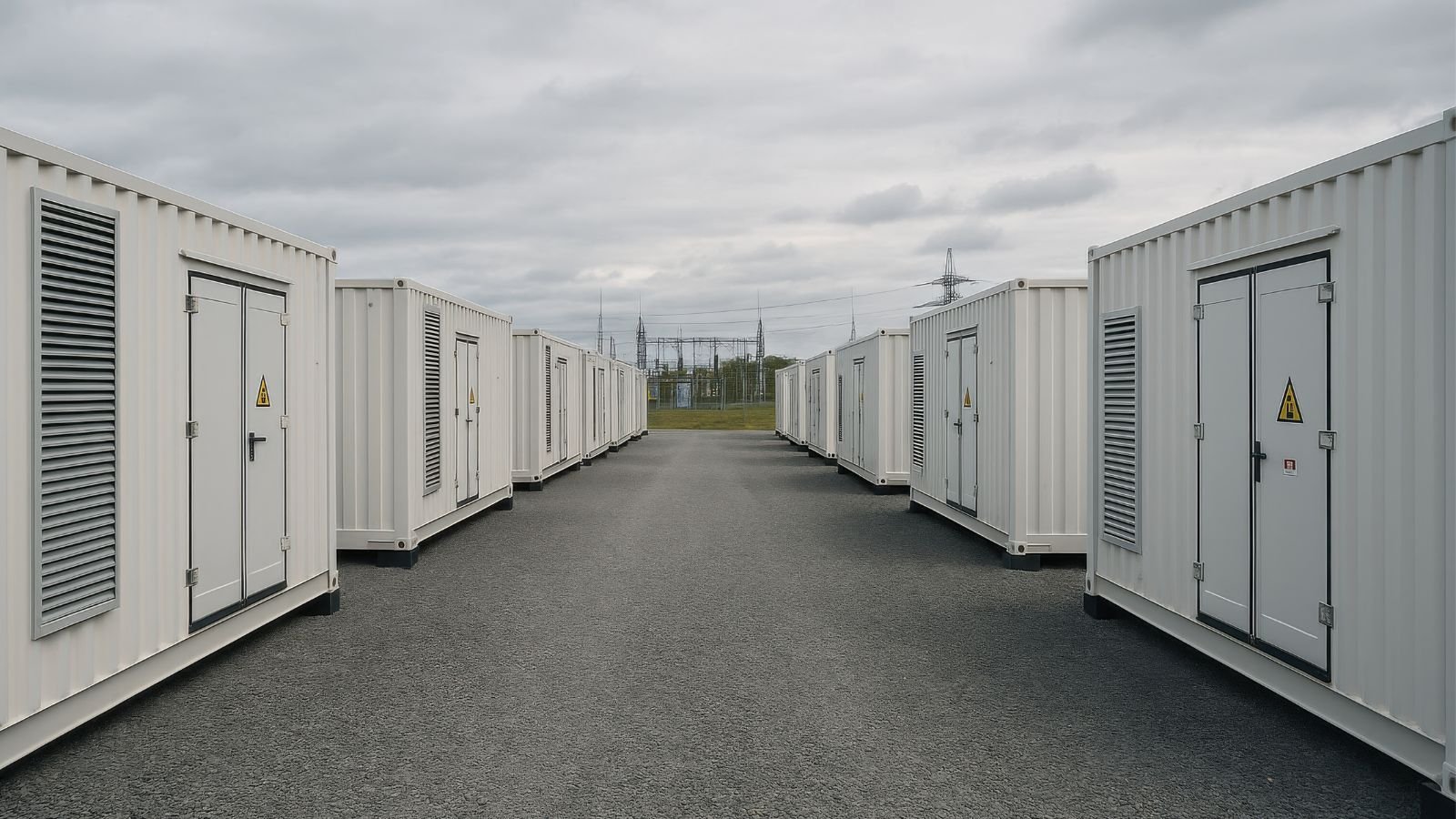
In 2018, less than one gigawatt of battery storage was connected to the U.S. power grid. By 2025, however, the U.S. surpassed 30 gigawatts of battery storage capacity. Arizona ranks third in the nation for installed battery storage and is forecasted to almost double our capacity to nearly 8 GW by the end of the year.
And according to energy analytics firm Wood Mackenzie, another 93 gigawatts of battery storage should be built over the next five years across the country.
Some of that growth can be explained by the continuation of tax incentives for energy storage under President Trump’s One Big Beautiful Bill. In fact, the Wood Mackenzie forecast jumped by 15% compared to what was expected before the bill passed in the summer of 2025.
But a far bigger driver is the falling cost of battery storage technologies. Most of those technologies are industrial-scale versions of the lithium-ion batteries that power our cell phones, laptops and other everyday electronics.
And for the past decade, the cost of lithium-ion batteries for grid storage has fallen by an average of 8 percent per year. When you look at a wider range of energy storage technologies, the costs fell by 31 percent last year, according to analysts with BloombergNEF.
Not surprisingly, as costs fall, the reliability benefits of energy storage are becoming more appealing to utility companies, businesses and power grid operators.
In fact, a closely watched report on the stability of the North American power grid recently found that “reliability improvements were observed in areas with high concentrations of battery energy storage systems,” even as the wider system was strained by growing demand from data centers and the impacts of severe weather events.
This makes perfect sense when you think about it. Now that electricity demand in America is growing again, power grid operators need as many backup sources as they can get their hands on.
Yes, we need to build the data centers that will keep America dominant in the development of artificial intelligence. And yes, bringing home as much manufacturing capacity from overseas is a must.
But the American public does not – and will never – support the idea of blackouts due to an overburdened power grid. Rather than make do with a limited number of energy sources, they are quite simply demanding more.
This is why the outlook for energy storage, along with many other power sources in America, remains so strong. And, if our leaders have the good sense to follow market signals and some common sense, the end product will be a growing power grid that is more reliable than ever.
Andy Tobin is former speaker of the Arizona House and a former member of the Arizona Corporation Commission. He is president and owner of Tobin Business Solutions LLC and director of The Western Way’s Arizona Rural Energy Network. Reach him on X, formerly Twitter, @Andy_Tobin.