
A new national poll from the Conservative Energy Network delivers a message that should resonate with every policymaker, utility executive and community leader in the West: Americans are feeling real pain from rising energy costs — and they want action, not ideology.
The survey, conducted by Cygnal in early May, polled 1,500 likely general election voters nationwide. The findings are striking in their breadth and their bipartisan consistency — and they reinforce everything The Western Way has been hearing on the ground in the states where we work.
The Backdrop: Costs Are Squeezing Families
More than four in five respondents — 82 percent — say they are concerned about the affordability of their electricity bills. Nearly three in four report their electricity bill has gone up over the past two years. And a majority say their household's financial situation has gotten worse over the past year. This isn't an abstract policy debate. Energy affordability is a kitchen-table issue, and voters know it.
When asked to rank their top energy policy priorities, 62 percent of respondents said keeping electricity costs affordable for families. Grid reliability and blackout-proofing came in second at 33 percent. Those are the same two priorities that drive the energy conversation across the rural West — and they should be driving the conversation in Washington, too.
The Grid Is Aging — and Voters Know It
Here's a number that should get every member of Congress's attention: 92 percent of respondents say it is important to modernize and upgrade the U.S. electricity grid. That holds across every demographic and partisan group at 91 to 94 percent. Meanwhile, 81 percent believe the current grid is incapable of reliably meeting growing electricity demand from AI data centers, manufacturing reshoring and electrification, and say significant upgrades are needed.
Voters aren't naive about the costs. Roughly half believe grid upgrades will ultimately raise consumer bills, while only a third believe they'll bring prices down. But when the tradeoff is spelled out clearly — lower bills in the long run and greater reliability, even at a small short-term cost — support jumps to 78 percent. That number holds at 79 percent among Republicans, 82 percent among Democrats and 72 percent among Independents. Grid investment isn't a partisan issue. It's a math issue.
Permitting Reform Has a Mandate
Three-quarters of respondents support streamlining the federal permitting process for new energy generation — including nuclear, natural gas, solar and wind — as long as environmental and safety standards are maintained. And 73 percent support streamlining federal transmission permitting when landowner rights are protected. Support is remarkably stable across parties, ranging from 70 to 77 percent regardless of partisan affiliation.
This is exactly what The Western Way has been arguing for years. Whether it's geothermal projects stuck in a decade of BLM review, solar installations waiting on redundant environmental assessments, or transmission lines that take longer to permit than to build, the permitting system is the single biggest obstacle to delivering the affordable, reliable energy that voters are demanding. The poll confirms what the market already knows: the bottleneck isn't capital or technology. It's red tape.
All of the Above Wins
When voters are asked about their preferred energy strategy, the largest group — 35 percent — favors using every available energy source to keep costs low and the lights on. And when presented with a comprehensive framing — an energy policy that uses every available source on a level playing field, modernizes the grid, and lets competition drive costs down — 72 percent agreed.
That's the "all of the above" approach in a single poll number. Not wind versus gas. Not solar versus nuclear. All of them, competing on a level playing field, with a modern grid to move the power where it's needed. It's the same approach that has made states like Utah, Arizona, Nevada and South Dakota some of the most reliable grids in the country, as we documented in our Red State Reliable report earlier this year.
Data Centers Should Pay Their Own Way
One of the poll's most striking findings concerns the surge in electricity demand from AI data centers and large industrial users. An overwhelming 83 percent of respondents — 85 percent of Republicans, 82 percent of Democrats, 87 percent of Independents — support requiring these large users to demonstrate how they will power their operations before receiving permits to build. And 54 percent say the companies themselves, not ratepayers and not the federal government, should bear the cost of upgrading the grid to serve them.
That's a powerful consensus, and it cuts to a concern we hear regularly in Western communities: growth is welcome, but the people who were here first shouldn't be stuck with the bill. If data centers and large industrial users want to plug into the grid, they should be part of the solution — bringing new generation online, investing in transmission and storage, and ensuring that existing ratepayers aren't subsidizing someone else's electricity demand.
An Electoral Issue — Not a Niche One
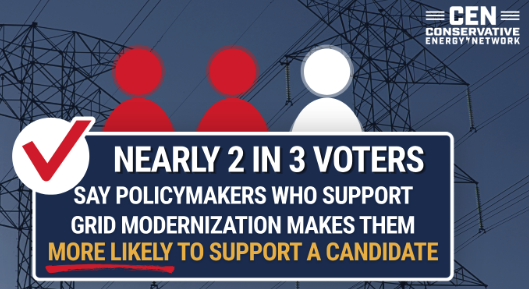
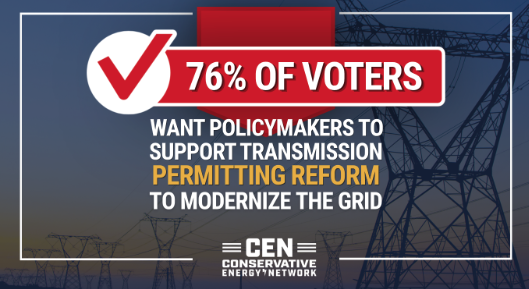
For candidates and elected officials, the electoral signal is unmistakable. Nearly 80 percent of respondents say a candidate's position on energy affordability and electricity costs is important to their vote. Sixty-four percent say they would be more likely to support a congressional candidate who backs grid modernization and expanded domestic energy production. And 76 percent want their representative to support legislation that speeds up permitting, expands production and modernizes the grid.
Energy isn't a side issue anymore. It's a voting issue — and the voters have made clear which direction they want to go: more production, a better grid, faster permitting and an all-of-the-above strategy that keeps bills down and the lights on.
The Bottom Line
The CEN poll confirms what we see playing out every day across the West. In Utah, 41 utility-scale renewable energy projects represent $8.4 billion in construction and investment. In Nevada, billions of dollars in solar, storage and geothermal development are waiting on federal permits. In Arizona, utilities are adding thousands of megawatts of new capacity because the market demands it. In Colorado, farmers and ranchers are adding energy production to their operations because the economics work.
The poll tells us that voters across the country are ready for the same approach: pragmatic, market-driven energy policy that prioritizes affordability, reliability and American energy independence. The question isn't whether there's a mandate for action. The data make that clear. The question is whether Washington will keep up.