
Bill to demystify tax credits would have been a win for fiscal conservatism and clean energy

This opinion piece from TWW’s Steve Handy originally ran in the Salt Lake Tribune on March 16, 2023 and can be accessed here.

Bill to demystify tax credits would have been a win for fiscal conservatism and clean energy

Can you be fiscally conservative and support tax credits for renewable energy projects and other types of business investment?

As the state director of The Western Way, a non-profit focused on conservative and market-competitive solutions to environmental and conservation challenges, I get that question a lot.

And I can answer without hesitation: Yes.

I know this might clash with political and media stereotypes about energy and the environment. Big-government progressives are the champions of renewable energy and small-government conservatives only believe in fossil fuels — or so the narrative goes.

But the reality is much different. Case in point: The debate over a measure to reform clean energy tax credits in the Utah Legislature this year.

In early February, state Rep. Kay Christofferson, R-Lehi, introduced a bill – HB407 Incentives Amendments – that sought to reform the way a whole host of tax credits — from clean energy to historic preservation to motion picture production — are awarded by state officials.

While the initial draft of the bill would have immediately ended many of these tax credits, Christofferson listened to concerns and made some thoughtful changes.

The bill, as amended, would have brought new accountability and transparency measures to the way tax credits are awarded. Instead of just awarding credits to companies based on the paperwork they submit, HB407 would have required state officials to take additional steps of formally certifying their eligibility.

HB407 would also have required that state officials publish the details of each tax credit awarded on the internet, allowing the general public to decide for themselves if the incentives are worthwhile.

“Some of the credits are probably doing great things, and some we don’t know because we don’t have enough information on them,” Christofferson told the Salt Lake Tribune.

If HB407 had become law, state lawmakers and taxpayers would have had much greater visibility into Utah’s existing tax credits for wind, solar, geothermal and other forms of clean energy – along with other incentives for investments in other industries, too.

Then, armed with that information, the people of Utah and their elected representatives could decide what’s working, what isn’t and how it could be fixed. This would have been much more sensible than amending or repealing certain tax credits based on a political philosophy or a hunch.

In any debate about the tax breaks the state of Utah offers businesses, it’s also critically important to remember that our state economy doesn’t exist in a vacuum.

Utah is competing with other states for business investment – and those states offer tax incentives, too. While our biggest selling point will always be our commitment to free enterprise and a pro-business climate, we will also need to continue to offer modest tax incentives, some $200 million per year across all sectors, in order to stay competitive.

For perspective, $200 million is roughly 0.75% of Utah’s total state budget of approximately $29 billion per year.

And in the case of renewable energy, there’s a good reason for wanting those investments to be made here instead of another state.

In 2021, The Western Way commissioned an economic analysis of utility-scale renewable energy projects across 11 counties in Utah. By “utility scale,” the economists who prepared the report meant large wind farms, solar arrays and geothermal plants built by power companies, as opposed to rooftop solar projects and other renewable energy investments from individual homeowners and small businesses.

Over a roughly 15-year period, these large renewable energy projects generated $5.3 billion in construction and investment activity and more than 9,000 jobs.

These projects are mostly located in rural areas of the state and make a valuable contribution to the local tax base in these communities. The report from $24.6 million in annual property tax payments to local governments, in fact – money that supports public schools and other essential local services.

It’s clear that wind, solar and geothermal energy makes a major contribution to our successful state economy. Because of our wide-open spaces and high altitude, southern Utah in particular is attractive to utility scale solar.

The economics work, but offering targeted tax breaks to businesses in this sector may also be necessary to prevent other states from luring these projects away. As long as Utah taxpayers see a return on that investment, I’d argue it’s worth it.

Should those tax breaks remain permanent, or should they be phased out over time? I don’t pretend to know the answer to that question. But as a fiscal conservative, I do know that any answer should be based on the facts – and bills like HB407 can make those facts easier for the general public to access.

Steve Handy is a former Utah legislator and the Utah director for The Western Way, an organization focused on market-competitive solutions to environmental and conservation challenges.

Energy Innovation Spotlight: Spiral Welded Wind Turbine Towers Move to Commercialization

Earlier this month, Keystone Tower Systems and GE announced a major milestone in the development of spiral welded wind towers with the installation and operation of the first such tower on a 2.8MW GE turbine.  Keystone Tower System, headquartered in Denver, CO, is driving innovation in the market which could fundamentally change the economics, manufacturing, and installation of wind projects across the country. 

Spiral welded towers can be twice as tall and 10 times faster to build than conventional towers.  They also use less steal, so they are also more affordable than conventional towers.   Additionally, and perhaps most importantly, Keystone’s proprietary manufacturing process will eventually be deployed on-site at wind farms.  This will eliminate tower diameter restrictions by eliminating the need for delivery height restrictions on bridges and overpasses.   All of this results in taller towers that can access better and more consistent wind resources which will lower costs and land usage. 

Using on-site tower manufacturing will also create new economic benefits for communities where wind farms will be located, such as more local jobs during the construction phases and direct spending in local economies to build the towers. 

“This is the culmination of a dream we had to bring advanced manufacturing to the tower industry to help drive down the cost of wind energy and expand where wind is competitive into new regions,” said Eric Smith, Keystone’s co-founder and CTO. “I’m very proud of the years of hard work our team has invested in developing and scaling up tapered spiral welding.”  

“This collaboration with Keystone is an example of GE’s commitment to working with partners to bring new and innovative technology to the wind industry and advance domestic manufacturing,” said Vic Abate, GE Renewable Energy’s CEO, Onshore Wind. “We are delighted to be a part of this exciting opportunity for our workhorse products, with the goal of providing affordable, sustainable renewable energy to our customers and helping to deliver on the energy transition.”

Private sector innovation, market forces, and early stage R&D investments from the Department of Energy are driving this rapidly advancing technology which could have profound impacts on how wind energy gets built in the United States. 

Watch the video below to see how spiral wielded wind tower manufacturing works:

GUEST COLUMN: A more resilient power grid is crucial

This piece from TWW’s Greg Brophy first ran in The Gazette on February 5, 2023 and can be accessed here.

The North American power grid is a modern technological miracle: Almost 6,000 power plants and more than half a million miles of transmission lines, spanning the United States, Canada and parts of Mexico.

The size, scope and complexity of our grid is so vast, it’s often called “the world’s largest machine.” And like any machine, it requires maintenance, repair and upgrading over time.

But in recent years, power grid operators have also had to deal with something else: deliberate attacks on the electrical system. And it’s a threat that we need to take more seriously here in Colorado.

This issue gained fresh attention in December when gunfire crippled two electrical substations in Moore County, N.C. The attacks left 45,000 customers without power for days and forced critical local services, such as water systems and health care facilities, to generate their emergency power until the damage could be repaired.

In the words of one state official, the attackers turned a vibrant rural community into a “ghost town” for days. Many residents found conditions unlivable and fled the area, while those who remained were subject to public safety curfews.

Just before the North Carolina incident, the Department of Homeland Security issued a bulletin warning of increased chatter among domestic extremist groups about attacking the power grid. In fact, physical and cyber threats against the grid, from domestic and international actors, have been building for years.

In 2022, physical attacks and incidents of computer hacking against electrical infrastructure surged to their highest level in a decade, according to an analysis of federal incident reports by Politico.

A separate review of federal data also found that human-caused grid disturbances are a bigger threat in the Western U.S. and Western Canada than anywhere else in North America. The number of cases on the Western grid is up 46% since 2011, in fact.

So what can be done to thwart these efforts?

While there is a role for increased physical security, it’s clear that we cannot build a fortress around the power grid. It’s simply too large and too much a part of our daily lives for that kind of response.

Here in Colorado, however, the beginnings of a solution are starting to take shape.

To prevent attacks from succeeding, Xcel Energy is investing in technology upgrades and cybersecurity enhancements. In 2021, those investments totaled more than $100 million.

But Xcel is also exploring other ways to prevent attacks on the power grid, by changing the rules of the game. The state’s largest utility company is testing technology that will make the grid less centralized and therefore limit the impact of an attack or natural disaster in any single location.

The Community Resiliency Initiative is building “microgrids” in six locations that are designed to function independently if there’s a problem on the wider Xcel system. Using battery storage, the microgrids will keep electricity in reserve for homes and businesses during a natural disaster or a human-caused outage.

These steps are encouraging, but given the highly regulated nature of the grid, this is not a challenge that utility companies and power system operators can meet on their own.

For example: State legislators and regulators should explore ways to increase penalties for successful and attempted acts of electrical grid sabotage. Better still, they should also ensure that the security plans developed by utility companies receive closer scrutiny and are updated to match the heightened threats facing the grid.

But tougher penalties and enhanced security is only one side of the coin. Lawmakers and regulatory officials should also work with utility companies to speed up the modernization of the power grid, so that even successful attacks have little impact.

Microgrids are definitely part of the solution. But bigger and more diverse storage options for the larger grid are important too, such as the molten salt technology that Xcel is exploring as an option for the Hayden coal plant site in northwest Colorado.

Likewise, distributed energy sources — in the form of rooftop solar panels, hydrogen fuel cells, advanced geothermal systems and technologies that use waste heat from industrial processes to generate electricity — can play a much bigger role.

But often, the barriers to building a stronger, more resilient grid aren’t technological — they’re regulatory, legal and political. After all, most of the laws governing the electricity sector are based on what the power grid looked like in the mid- to late- 20th century.

But time doesn’t stand still, and neither should we. The world’s largest machine is due for a major tune-up, and the longer we wait, the more expensive it will get.

Greg Brophy of Wray is a farmer and former state senator. He is the Colorado director of The Western Way.

CO Legislation Looks at Nuclear, Pumped Hydro Storage

Two pieces of legislation introduced this year in Colorado would expand the state’s use of alternative energy sources and employ an all of the above approach to meet the state’s emission requirements.

HB-1080 from Representative Ty Winter and Senator Byron Pelton encourages Colorado to look at the possibility of small modular nuclear reactors by authorizing an in-depth feasibility study.  The study would look at the policies, economics, safety, reliability and environmental impacts of the use of small modular nuclear reactors. 

The bill also increases the current limit of pumped hydro storage facilities from 15 MW to 400 MW, opening the door to larger utility scale pumped hydro storage projects.  Pumped hydro storage projects already must utilize renewable energy in order to be eligible under the definition of recycled energy so increasing the cap makes sense and would serve to benefit Colorado’s growing renewables industry. 

SB-73 from Senator Larry Liston would add nuclear energy to the state’s definition of clean energy. The bill notes that nuclear energy is the largest source of carbon free electricity and has a 92.7% capacity factor which would help prevent future blackouts.

These all of the above approaches are common sense ways to enhance Colorado’s resource mix by focusing on reliability and base load generation.   

Battery Sector Key to Diversifying NV's Economy

A new trade association, the Nevada Battery Coalition, was formed in Nevada this week focusing on highlighting and increasing the opportunities that lithium battery production is bringing to Nevada.

Nevada is a leader in the mining, production, and recycling of lithium batteries and has already seen billions of dollars in investments and thousands of jobs across the state to grow the industry. 

“The current investment in this industry has produced profoundly positive environmental, economic, and national security advantages, all of which are strengthened by uniting the industry through the Nevada Battery Coalition,” said Caleb Cage who is coordinating the new group. 

Companies participating in establishing the Nevada Battery Coalition include 3PL Operating, Inc., Albemarle Corporation, American Battery Technology Company, American Lithium Corp/Tonopah Lithium Corp, Aqua Metals, Inc., Comstock Inc., Cypress Development, Dragonfly Energy, Ioneer USA Corporation, Lithion Battery, Lithium Americas, NV Energy, Tesla, and Quantum Copper.

To underscore the importance of the growing battery sector, just days after new trade group was formed, Nevada’s Redwood Materials announced it would receive a $2 billion Department of Energy loan to help build out its $3.5 billion Nevada recycling and remanufacturing. The project is expected to create about 3,400 construction jobs and employ about 1,600 full-time workers. The company's presence in Nevada started under former Gov. Brian Sandoval.  The investments and subsequent jobs will help Nevada’s newly elected Governor Joe Lombardo meet his goals to diversify Nevada's economy.

"This is what we're going to have to do to have success in the state of Nevada," Lombardo said. "We can't have all our eggs in one basket."

Major Investment in Nevada as Pro Development Governor Begins First Term

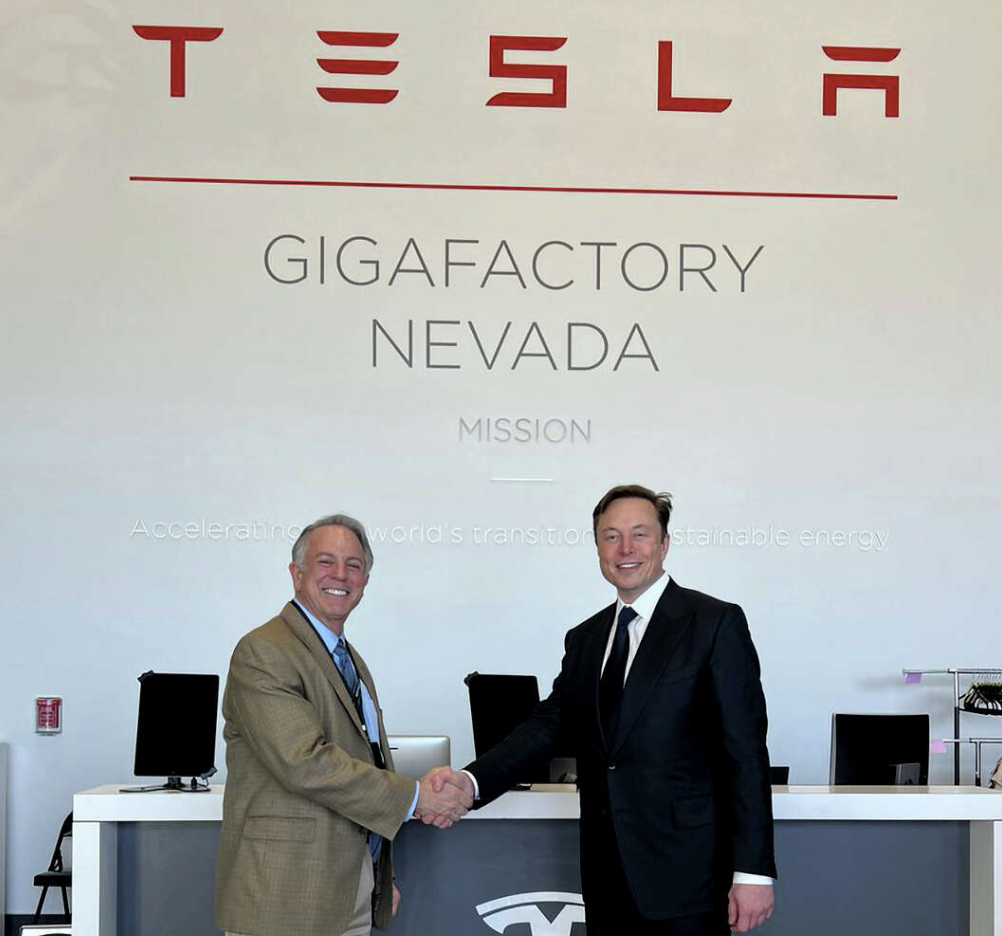
On January 24th, Telsa announced a major expansion of their Northern Nevada manufacturing facility, Giga Nevada.  Tesla head, Elon Musk made the announcement along with Nevada Governor Joe Lombardo in front of workers at the facility.

In noting the expansion’s major economic impacts for the state, Governor Lombardo said, “My three pillars as your Governor is the economy, education, and quality of life – public safety.  Now today with this expansion its even going to double the quality of life and the economic engine and the drivers for us to be successful in whole state Nevada and in particular to Northern Nevada.”

The $3.6 billion dollar investment announced will include:

  • Construction of 4 million square feet of new manufacturing footprint

  • Hiring 3,000 Nevadans for new jobs

  • Semi-truck manufacturing capability

  • 100 GWh of new 4680 battery cell production

Since 2014, Tesla has invested $6.2 billion in Nevada to build its current 5.4 million square foot Gigafactory which has generated $17.1 billion in cumulative economic output for Nevada, $4.2 billion in wages and $117 million in tax revenues. 

In terms of battery production, the plant has exceeded expectations and has already produced:

  • 7.3 billion battery cells (37 GWh+ annually)

  • 1.5 million battery packs

  • 3.6 million drive units

  • 1 million energy modules (14 GWh+ total)

The announcement came a day after Governor Lombardo delivered his first State of the State Address where he laid out the priorities of his administration and focused on the importance of economic development saying:

“Our best opportunities for economic growth are providing, a pro-business environment for the 350,000 businesses that currently call Nevada home and offering a pro-development invitation for the expansion of new business.

Whether it’s closing the lithium loop, unlocking innovation and investment in logistics, entertainment, science and technology, or embracing entrepreneurship, the message is, that Nevada is ready to partner.”

-Governor Joe Lombardo


Arizona Attracts Major Investments in Clean Energy Sector

Arizona’s strong business climate is racking up major wins in the clean energy sector. 

In just the last few weeks, Arizona has seen a surge of investment in battery and solar cell manufacturing driving thousands of new jobs for Arizonans and billions in investments from the private sector.


JA SOLAR ANNOUNCES FIRST U.S. SOLAR MODULE MANUFACTURING FACILITY IN PHOENIX

Representing a $60 million investment, the facility will create over 600 new jobs

“We are very excited to be able to set up the first U.S. solar module manufacturing facility in Arizona to provide our customers in the U.S. the flexibility and ease of access to JA Solar’s high-performance PV products,” said Aiqing Yang, President of JA Solar. “JA Solar thanks all the partners in Arizona, especially the ACA, GPEC, and the City of Phoenix for their great support and tremendous assistance during the entire process of site selection and space leasing in preparation to establish the manufacturing facility. Solar is a critical part of renewable energy and we are thrilled to be a part of the effort to meet the goal of carbon neutrality by 2050 in the U.S.”


SION POWER ANNOUNCES PLANS TO EXPAND BATTERY MANUFACTURING OPERATIONS IN TUCSON

The SP-1 factory expansion will be complete by 2026, creating over 150 jobs

“The global construction of battery manufacturing plants is occurring at a rapid pace, and the United States can’t be left behind,” said Tracy Kelley, CEO of Sion Power. “With our facility expansion in Tucson, Arizona, it will allow Sion Power to further our mission of scaling battery manufacturing from research and development to commercialization. This enables us to better serve our customers and their applications.”


AMERICAN BATTERY FACTORY SELECTS TUCSON AS SITE FOR ITS FIRST BATTERY CELL GIGAFACTORY IN UNITED STATES

American Battery Factory’s first site in a planned network of giga-factories to produce LFP battery cells, 2 million square feet, providing an estimated $1.2 billion in capital investment, $3.1 billion in economic impact to the state and accelerating the growth of the clean energy economy across the country. Approximately 300 high-paying jobs.

“This investment represents a generational opportunity both for us as a company and for Tucson as a community as a means to truly make energy independence a reality for everyone,” said Charles. “Batteries make shifting to an entirely green energy economy possible. With this first factory, we will secure a strategically positioned company headquarters while taking the critical first steps in making it possible to one day move the country and the entire world to 100% renewable power. We are honored to start this journey in Tucson and give back to the community through innovation, quality job creation, revenue generation and environmental protection.”

Regulators Investigating Whether Clean Energy Incentives will Help Real People

This piece from TWW’s Arizona State Director Jaime Molera, first ran in the Arizona Capitol Times on December 20, 22022 and can be accessed here.

Before this year’s election, President Joe Biden and Congress passed a package of almost $370 billion in tax breaks and other incentives to accelerate the deployment of clean energy sources across the U.S. economy. 

To be clear: The cost of wind, solar and other renewable energy sources has plummeted over the past 10 years, meaning they are already cost competitive with fossil fuels like coal and natural gas. So, the newly approved tax breaks will simply accelerate a shift in the energy sector that market forces had already started. 

Unfortunately, these tax breaks were rolled into a larger bill called the Inflation Reduction Act, which received a great deal of pushback for the cynical way it was named and then marketed to voters as they struggled with 40-year highs in inflation during an election year. 

However, now that the 2022 midterm elections are behind us, it’s easier to put politics aside and see what these clean energy tax breaks could do for working families and businesses here in Arizona and across the rest of the country.  

For example: Will these tax breaks actually result in lower residential energy bills and leave households with more money in their pocketbooks at the end of the month? Or will big energy companies and other special interests find a way to pocket these tax breaks themselves? 

The Biden administration may have some control over who sees the benefits of these clean energy tax incentives, but in my opinion, the real work will be done at the state level by utility regulators like the Arizona Corporation Commission (ACC). 

For that reason, we should all be grateful that ACC Chairwoman Lea Márquez Peterson is on the case. 

In late November, Peterson called on the state’s utility companies to show regulators how they will put the federal government’s new clean energy tax incentives to work.  

“I don’t agree with all aspects of the Inflation Reduction Act, but I do believe in reducing electric utility bills for Arizona consumers in all forms,” Peterson said

For utility companies, the bill’s tax breaks have the potential to reduce the cost of building new power generation and purchasing electricity from outside sources, Peterson added.  

But given what the American people were promised when the bill was passed, “the financial benefits must flow to ratepayers,” she said. Without proper oversight, the cost savings “will not be felt immediately, or at all” on people’s utility bills, Peterson said. 

“I believe we have a duty to ensure that ratepayers see lower costs as a result of the Inflation Reduction Act,” she said. 

But the ACC chairwoman, who is the first Latina to hold statewide public office in Arizona, didn’t just turn up the heat on the utility companies she oversees. Peterson also demanded that the Biden administration and Congress finally do something about the red tape and bureaucratic inertia that has blocked major energy and mining infrastructure projects across the Western U.S. 

These permitting roadblocks are slowing down, and threaten to completely derail, the approval of solar arrays, wind farms, advanced nuclear plants, geothermal facilities, power transmission lines and other construction projects that are essential for the continued expansion of homegrown clean energy, especially here in the West. 

“In the United States, we can mine and manufacture the resources necessary to support a 21st Century energy economy,” Peterson said. “And we can do it more sustainably and with better technology, quality, and workplace standards than any other country. But federal regulations are getting in the way of siting new energy production facilities and mining operations in the West.” 

After passing the clean energy tax breaks, “Congress also promised to address permitting reform [and] Congress must keep its promise,” Peterson concluded. 

Peterson’s call is supported by many in the mining industry and even in the halls of academia. Recently, the Payne Institute for Public Policy at the Colorado School of Mines issued a timely warning: “Without permits to build things, there will be no clean energy boom.” 

“Clean energy that exists only on paper doesn’t do anyone any good,” the university-based think tank wrote in a column published by The Financial Times. “To be real, it must be permitted, and then built.” 

For many reasons, Arizona is a pivotal state to the political and economic future of our country. If they’re smart, elected officials and bureaucrats in Washington, D.C., will therefore pay close attention to the proceedings of the ACC and take Chairwoman Peterson’s challenge on infrastructure permitting seriously.   

Jaime A. Molera is former Arizona state school superintendent, partner of Molera Alvarez, and the Arizona director for The Western Way, a nonprofit organization that builds support for market-driven solutions to environmental challenges. 

Arizona’s Burgeoning Hydrogen Economy Advances

This month, Nikola Corporation and Plug Power announced a strategic partnership to advance Arizona’s hydrogen economy.

Arizona-based Nikola Corp. is already a global leader in zero-emissions transportation and energy supply and infrastructure solutions, and is also a leader in the research and development of hydrogen-based fuels. Plug Power is a leading provider of turnkey hydrogen solutions for the global green hydrogen economy. Together, Nikola and Plug will take Arizona’s burgeoning hydrogen economy to the next level.

Plug offers an end-to-end green hydrogen ecosystem using PEM electrolyzer solutions, which produce carbon-free green hydrogen using renewable electricity and water. Green hydrogen is a cost-competitive form of energy and the only form of hydrogen created using clean renewables.

Plug liquifies hydrogen for transportation at atmospheric pressure and temperatures below -400°F with an ultra-low energy consumption twin-expander refrigeration process that simplifies and streamlines operation and maintenance, resulting in cost savings for our customers. With its fleet of cryogenic trucks, Plug uses a fleet of cryogenic trucks to transport green hydrogen from production plants to users around the world daily.

With last week’s announcement, Plug will now provide its fully integrated liquefaction system for Nikola’s recently announced hydrogen hub project in Buckeye, Arizona, which is currently going through a permitting and rezoning process as well as the procurement of long-lead equipment. The project will be engineered to produce 30 metric-tons per day in its first phase, scaling up to 150 metric-tons per day. The low carbon hydrogen supply from the hub will further support the deployment of the Nikola Tre FCEV program and Nikola’s hydrogen energy business.

In addition, Nikola and Plug have also executed a 125 metric-tons per day Green Hydrogen Supply Agreement, which is expected to provide Nikola with a minimum of 100 metric-tons per day of hydrogen with the option to increase volume over time. This will allow Nikola to source hydrogen from multiple locations across the country as Plug continues to bring on new supply facilities.

Of the partnership, Cary Mendes, Nikola President, Energy, said, “Nikola and Plug share a common vision for sustainable, efficient, energy solutions which supports our commitment to decarbonize the transportation industry. This strategic relationship will help underpin Nikola’s ambitious growth plans to expand the hydrogen energy business and to support the adoption of Nikola’s zero-emission Class 8 trucks.”

New Chevron Geothermal Project Coming to NV

Late last week Chevron and Baseload Capital announced a new joint venture to explore geothermal development opportunities in the United States.  The companies will collaborate on driving geothermal opportunities – including identifying the best options for development, operations and progressing the next generation of geothermal technologies from pilot to commercial scale.

The first project identified by the joint venture will be developed in Nevada’s Esmeralda County.  Currently, the majority of Nevada’s geothermal electrical generation plants are located in the northern portion of the state. This new project shows the potential for geothermal projects throughout the state.

“We are pleased to be partnering with Baseload Capital on this joint venture and believe we are in a prime position to lead in the geothermal space where we will lean on our experience and technical strengths. We believe that to make the geothermal ecosystem a reality, we must take these important steps through collaboration and partnership, and this example with Baseload Capital is a great start towards pursuing our lower carbon goals for the future,” said Barbara Harrison, Vice President, Offsets and Emerging, at Chevron New Energies. 

“It is time for the geothermal industry to take its place as an obvious part of the energy mix. Geothermal should be the new normal, becoming as standard to the energy mix as GORE-TEX is for outdoor clothes. Right now, everything is in the industry’s favor to move from niche to mainstream. We have no time to waste and no excuse for not picking up the pace here and now. Together with Chevron we believe that the transition to a greener planet, with the help of geothermal, is going to be much faster,” said Alexander Helling, CEO at Baseload Capital.

Nevada currently ranks second in the country for geothermal electrical energy production. Nevada’s geothermal plants can currently generate up to 827 MW of power in any given hour. Nevada has 26 plants in 17 different locations.

This latest announcement shows the strong interest in Nevada geothermal resources which could translate into new jobs and significant rural economic development.

Rod Pelton on Economic Opportunity for the Eastern Plains

Colorado House Representative and State Senator-Elect Rod Pelton is a third generation farmer and rancher from Colorado’s Eastern Plains. He’s an unflinching advocate for rural Colorado and has focused his time serving in the Colorado House of Representatives to drive real economic opportunities for his constituents.

Earlier this month Rep. Pelton highlighted the economic opportunities that the Colorado Power Pathway’s transmission line would bring to the Eastern Plains in a letter to the Sterling Journal-Advocate:

“Many of my constituents throughout the Eastern Plains are in the agricultural business and know first-hand how difficult and challenging the work can be, but they deserve financial security. After all, their success contributes to our local communities and our western quality of life.

One of the ways I see rural Colorado being able to experience economic growth that the Front Range has benefited from is through the potential land-lease options because of the Colorado’s Power Pathway – a $1.7 billion investment from Xcel Energy that will harness energy from the critically important rural part of the state.

Hear me out – it’s important to make it financially feasible to develop and produce the natural resources that this state offers, while we develop our renewable energy sources and make them competitive with traditional resources.

The Pathway project gives us this chance. It not only offers agricultural landowners an opportunity to make money off their property, but this investment in the region bolsters our competitive edge and positions us for greater economic prosperity.”

Click here for the full version Rep. Pelton’s letter that ran in the Sterling Journal-Advocate on December 7, 2022.

AZ ACC Looks at Federal Funds and Permitting Reform

Yesterday, the Chair of the Arizona Corporation Commission, Lea Márquez Peterson, requested that regulated utilities in Arizona communicate to the ACC on how they would be pursuing new federal infrastructure funds and credits to deploy clean energy.

Chair Márquez Peterson noted that it was important to better understand how the new federal provisions could benefit ratepayers, “As chair of the Arizona Corporation Commission, I believe we have a duty to ensure that ratepayers see lower costs as a result of the Inflation Reduction Act. As commissioners, I believe we must study these credits thoroughly and determine how, exactly, the investment and production tax credits provided by the Inflation Reduction Act should be applied to Commission policies and procedures.”

Chair Márquez Peterson also described the importance of permitting reform and the role that states can play to ensure federal incentives are properly applied, saying, “Congress passed the Inflation Reduction Act to reduce inflationary pressures on American consumers, including for the price of gas and electricity. But these provisions will not be felt immediately, or at all, if they are not properly applied. Congress also promised to address permitting reform upon the passage of its Inflation Reduction Act. Congress must keep its promise.”

Arizona and the rest of the Western United States will play a vital role in efforts to increase domestic manufacturing, mining and processing of critical minerals, and the deployment of advanced energy solutions over the next several decades. Opening this docket will ensure that the ACC and regulated utilities in Arizona are able to keep consumer rates down while leading on clean and reliable energy production.

Requested comments from the regulated utilities will be provided via ACC Docket Number E-99999A-22-0046 (Resource Planning and Procurement for 2021, 2022, and 2023).

NV's Redwood Materials Brings Battery Supply Chain to U.S.

This month Panasonic Corp announced that it will buy battery cathode material from Carson City, NV based Redwood Materials for use in the company’s new Kansas manufacturing plant. The multi-year deal valued at several billion dollars will help reduce U.S. battery manufacturing reliance on China and shorten supply chains.

Redwood Materials has an established track record with Panasonic in Nevada where the two companies build battery cells in a joint venture for Tesla. Redwood Materials recycles scrape material from Panasonic and also supplies remanufactured anode copper foil.

Redwood Materials has also been expanding its business beyond recycling with recent announcements and a $3.5 billion investment to scale up production of cathode and anode materials. By 2025, Redwood plans to increase its production capacity to 100 gigawatt hours and by 2030 the company plans to produce 500 GWh, enough to supply batteries for 5 million electric vehicles.

Onshoring critical materials for battery production and shortening supply chains will drive down costs for batteries in the coming years and drive significant economic development opportunities for the United States.

Redwood Materials is a true pioneer forging a closed loop domestic supply chain for the fast growing lithium-ion battery market.

National Polling Results on Energy and Conservation

The Conservative Energy Network (CEN) recently released their 7th annual national survey focused on voter attitudes towards pressing energy and conservation issues. 

On November 15th, CEN hosted a poll briefing to present the results.  The briefing featured panel speakers Tyler Duvelius, external affairs director at CEN, Glen Bolger, partner and co-founder of Public Opinion Strategies (POS), Matt Moore, managing partner at First Tuesday Strategies and John Hart, vice-president and co-founder of C3 Solutions.

“Our survey results make clear that economic issues are at the top of voters’ minds as they cast their votes—and rightfully so,” said Tyler Duvelius, CEN director of external affairs. “With 47% of Americans believing their electricity bills are higher than average, it is more important than ever that the United States embrace an all-of-the-above approach to energy policy. Our survey found that Americans want more emphasis placed on all forms of energy—particularly wind and solar power. More domestically produced energy will lower our electricity costs here at home and will forge America’s path to a clean energy future.”

Poll Briefing can be accessed here.

Poll Results can be accessed here.

Advanced Materials Developer Expands in Arizona

Earlier this month, JX Nippon Mining & Metals USA, Inc. (JX USA) broke ground on the company’s new state-of-the-art electronic materials manufacturing plant in Mesa, Arizona. JX USA has had a presence in the East Valley for more than 30 years and in that time has grown to over 125 employees. The new plant is expected to be operational in early 2024 and will create more than 100 additional jobs by 2025.

The planned 273,000 square-foot facility located on 63 acres will produce sputtering targets for semiconductors for North American and European markets and is expected to produce more than double the production of JX USA’s existing plant in Chandler, Arizona. The facility itself will contain a large production area and office space in addition to “welfare facilities” and garden and will also serve as an incubator for new business development. JX USA intends to make the new Mesa facility the center of its business in the advanced materials field in the United States and is continuing its work to “achieve stable provision of even higher-quality products” in an environmentally and socially responsible way. The company has a goal of reducing its carbon emissions by 50 percent by 2030 and achieving net-zero carbon emissions by 2050, with a variety of measures to achieve those targets including the use of carbon-free electric power, creation of renewable energy, and reduction of energy consumption.

The company has received numerous industry and company-specific awards, including from Intel, ON Semi, and TSMC, all of which have a presence in Arizona. Most recently, JX USA was awarded Intel’s 2022 EPIC Distinguished Supplier Award. In order to qualify, a supplier must “exceed expectations, meet aggressive performance goals, and score 80 percent or higher in performance assessments throughout the year. Suppliers must also meet 80 percent or more of their improvement plan deliverables and demonstrate formidable quality and business systems.” JX USA was one of only 26 suppliers in Intel’s global supply chain to earn this recognition.

Of the groundbreaking and JX USA’s Arizona expansion, Sandra Watson, President and CEO of the Arizona Commerce Authority, said, “Today’s groundbreaking showcases Arizona’s premier attractiveness for the semiconductor industry. JX USA has been a leading advanced materials developer in Arizona for more than 30 years, and we are excited to see them expand their legacy in Mesa.”

President and CEO of JX Nippon Mining and Materials USA Masago Kuwabara said, “We are proud to be moving forward on our commitment to manufacture electronic materials in the City of Mesa. With an outstanding team of designers and engineers, and a product strategy, we expect today to be just the start of a longstanding presence in this dynamic city.”

According to an Arizona Commerce Authority press release, JX USA chose Arizona based on “numerous positive factors, including business climate, infrastructure, talent, geographic location, and supply chain for the semiconductor industry.”

The City of Mesa is already a vibrant and growing city in the Phoenix metropolitan area and has proven to be an attractive location for the high-tech industry, now home to companies like Amazon, Apple, AT&T, Boeing, Facebook (Meta), and Northrop Grumman. Mesa is expected to continue to grow as a center for advanced industry and, of the announcement, City of Mesa Mayor John Giles said, “JX’s investment and commitment to Mesa further demonstrate the desire for leading advanced manufacturers to grow their business in our city.” Echoing that sentiment, Kevin Thompson, District 6 Councilmember, said, “I could not be more thrilled to welcome JX USA to Mesa. With their new plant in Mesa, JX Nippon Mining & Metals USA, Inc. (JX USA) is not only a win for Mesa, but a win for the region as well. Their commitment to manufacturing will allow them to further expand their production capacity for the semiconductor sector. Together, the investment and jobs that JX USA brings will be wonderful assets for this already active area.”

Congressman Curtis Holds Inaugural Conservative Climate Summit

On October 14th Congressman John Curtis (UT) convened Utah’s first Conservative Climate Summit.   Congressman Curtis brought together experts from agriculture, national security, and the private sector for a robust discussion about commonsense solutions to climate change and why conservatives should engage on the issue. 

Congressman Curtis urged conservatives to be a part of the conversation, otherwise we are more likely to see radical proposals like the Green New Deal. 

“Let’s be honest, we are allowing ourselves to be branded as not caring about the earth,” Congressman Curtis said. “I know Utahns, we care deeply about the earth. I like to tease Utahns that they’re the best environmentalists in the world. They don’t like to be called environmentalists, but they care deeply about this earth.”

The Summit also focused heavily on the importance of energy independence and national security.  Congressman Curtis told the audience that, “We can have energy independence as a county. As a matter of fact, we can be energy dominant throughout the world. We can have affordable and reliable power, we can have a strong economy, and we can reduce emissions. This is what conservatives bring to the table, is we know how to do this.”

Other speakers included Ambassador Robert O’Brien, former U.S. National Security Adviser from 2019 to 2021 under President Trump and Carson Jorgenson, Chairman of the Utah Republican Party, A. Scott Anderson, President and CEO of Zions Bank and Peter Huntsman, CEO of the Huntsman Corporation.   

Here is a link to the full summit agenda and breakout sessions.

https://curtis.house.gov/conservativeclimatesummit/

Colorado Eastern Plains Wind Tour

Earlier this month TWW visited the Rush Creek Wind Farm in Eastern Colorado with legislative candidates from across the Front Range to see firsthand how one of the largest wind farms in Colorado operates and to learn about its economic impacts to the state and regional economy.  Rush Creek is owned and operated by Xcel Energy and is the second largest wind farm in Colorado.  The farm spans four counties – Elbert, Lincoln, Kit Carson, and Cheyenne – and generates 600 MW of electricity or the equivalent of 325,000 homes.

Rush Creek is a major economic driver in those counties with the farm driving an estimated 2,970 jobs and $570 million in output during the construction phase.  Now in full operation, Rush Creek drives over 180 full time jobs and $33 million in annual economic output.   Rush Creek is also expected to result in $180 million in lease payments and local property taxes over the life of the project. NREL has conducted an in-depth analysis of the economic impacts of the project.


TWW got an on the ground look at operations on the Rush Creek wind farm and how Xcel and its partners manage the 95,000 acre site.


TWW also spent time with Rep. Rod Bockenfeld, Lincoln County Commissioner Steve Burgess, and Elbert County Economic Development Director Marc Dettenrieder to learn more about the local economic impacts of renewable energy development in Eastern Colorado. 

Arizona Continues to Lead in Automated Vehicles

Last week, Arizona celebrated the grand opening of TuSimple’s Tucson, Arizona facility to mark the expansion of the company’s research, development and operations expansion in Arizona.

TuSimple, founded in San Diego in 2015, develops “the world’s most-advanced self-driving technologies specifically designed for heavy-duty trucks” with the aim to “develop self-driving trucking technology to make freight transportation safer, more efficient, and environmentally friendly.”

TuSimple has had a presence in Tucson since 2017. Of the company’s Tucson operation, Xiaodi Hou, Co-Founder and CEO of TuSimple, said that since coming to Arizona, the “team in Tucson has developed and strengthened industry-leading technology that has made significant progress in advancing safe and reliable autonomous trucking – including the world’s first commercial trucking runs on public roads with no driver onboard.”

The company’s technology employs strategically located terminals to connect shippers, carriers, and fleets to the TuSimple Autonomous Freight Network (AFN), creating a “network effect” in which increased numbers of terminals and mapped lanes improve the overall value of the autonomous trucking service network. In addition, every autonomous truck uses proprietary three-dimensional high-definition digital maps, which serve as a “digital pathway for the L4 self-driving trucks to follow and support nearly all aspects of TuSimple’s autonomous trucking system by statistically encoding predictive knowledge of the road environment that has been accumulated over time to ensure optimal safety and efficiency.”

TuSimple’s technology is designed to solve multiple problems, including road safety, truck driver shortages, fuel efficiency and carbon emissions, and operational costs. According to TuSimple, its systems “can potentially save users up to 40% on operating costs while addressing a current shortage of some 60,000 truck drivers expected to double over the next few years.”

According to an Arizona Commerce Authority press release, the growing Tucson campus “will host the company’s expanding workforce and multiple state-of-the-art labs dedicated to developing and testing advancements in electrical engineering, sensor development, and mechanical engineering. Among other expansions, the facility will also host a new training lab for Test Engineers.”

In his remarks at the celebration event, Governor Doug Ducey noted Arizona’s increasing dominance in the advanced automotive industry, saying, “Arizona is the automated vehicle capital of the world, and TuSimple helped drive this innovation to our state. This expansion brings hundreds of well-paying, high-tech jobs to Southern Arizona and demonstrates once again that Arizona is the best place in the world to develop and scale advanced mobility technology.”

TuSimple is already running autonomous freight in Arizona in collaboration with commercial partners, including UPS, the Postal Service, McLane Cos., freight carrier U.S. Xpress, and Penske Truck Leasing, and the company has plans to continue expanding its interstate trucking routes and partnerships. Its growing presence in Arizona and the city of Tucson has already created hundreds of high-paying tech jobs and contributed to establishing Arizona as a hub of innovation, and its expansion plans will continue to play an important role in solidifying Arizona’s national reputation in this sector.

New Battery Recycling Facility to Help Close Domestic Supply Gap

This week, Heritage Battery Recycling announced plans to construct a new lithium-ion battery recycling facility in Eloy, Arizona. Heritage Battery Recycling is an affiliate of Cirba Solutions, a comprehensive cross-chemistry battery management and materials processor and a leader in the industry for the past thirty years.

The Eloy facility complements Cirba Solutions’ existing facility in Mesa, and will process lithium-ion end-of-life batteries and battery manufacturing scrap as well as provide additional services including disassembly, sorting, warehousing, and diagnostic testing. The end products from the facility will then serve as raw material for new cathode and battery manufacturing and help to close the domestic materials supply gap needed to support the growth of the electric vehicles market and increased need for battery recycling services. 

Of the announcement, Sandra Watson, President and CEO of the Arizona Commerce Authority, said, "This new EV battery recycling facility bolsters Arizona’s vibrant battery and electric vehicle supply chain and furthers Arizona’s reputation as an epicenter for lithium batteries. The innovative facility will produce battery materials to support the continued growth of electric vehicle manufacturers across Arizona and the United States. Arizona continues to be a magnet for technology and advanced industries.”

“The lithium-ion battery market is expected to grow exponentially over the next several years, with a projected market size approaching $25 billion by 2028,” Cirba Solutions President and CEO David Klanecky says. “Federal incentives for the purchase of EVs, requirements for domestic EV battery manufacturing included in the Inflation Reduction Act and state requirements like California’s recent move to require all new vehicles sold in the state to be zero-emission by 2035, ensure that lithium-ion battery recycling will be critical for auto manufacturers to meet demand and have a sustainable future.”

Pinal County, where the new facility will be located, is a burgeoning hub for electric vehicle manufacturing with both Lucid Motors and Nikola Motors also located there. The addition of the Heritage Battery Recycling facility further positions Arizona to meet growing regional and national demands for electric vehicles, which rely on lithium ion batteries, in an environmentally responsible way.

The facility, which will occupy more than 75,000 square feet, is estimated to provide 110 jobs in Eloy once construction is complete. The company expects to be fully operational by mid-2023 and will process enough battery material to support 50,000 EVs annually.

A Voice for Rural America Podcast


A Voice for Rural America, the podcast from the Congressional Western Caucus hosted by Congressman Dan Newhouse (WA-04) discussed commonsense energy policies this month. To listen, click the player above.

Congressman Newhouse interviewed Congressman Chris Stewart (UT-02), Greg Todd, Director of Utah’s Office of Energy Development, and Heather Reams, President of Citizens for Responsible Energy Solutions, CRES.

The episode took place during the 6th annual National Clean Energy Week, September 26-30th.  Congressman Newhouse and his guests discussed the importance of balancing clean energy development while still growing the economy and creating jobs.   

Listen in for a great discussion on domestic mineral production, transmission, and the importance of domestically produced all of the above energy from renewables to hydrogen, nuclear, and new technological breakthroughs.  As well as how Utah is at the tip of the spear in deploying advanced energy solutions.